
The Common Raven
Corvus corax - California Native Series

Corvus corax, or the Common Raven, has interesting relationships with many species. With large predators, they are known to act as sentries, pointing out potential prey to share[4]. With each other, they tend to keep to themselves or to small groups unless a large meal is available; then they work together to defend it[4]. With humans, they inspire stories of awe, fear, and gratitude across the Northern Hemisphere.
In Norse Myth, Hugin (thought) and Munin (Memory) are ravens who acted as the eyes and ears to Odin[7][4]. According to Eyak legend, the Raven stole the Sun, Moon, and Stars from a rich family to give the world light[8][9]. There are many indigenous stories about Ravens as tricksters and liberators, particularly in the Pacific Northwest[7][4][8][9][10]. On Libby, there were at least 149 books with Raven in the title, tied to stories of darkness, mystery, and romance. In 2011, there were at least 1400 published articles on this species alone[4]. Even now, it’s not uncommon on social media to find videos of people interacting with Ravens as pets (something I don’t recommend) or visitors out in the wild.
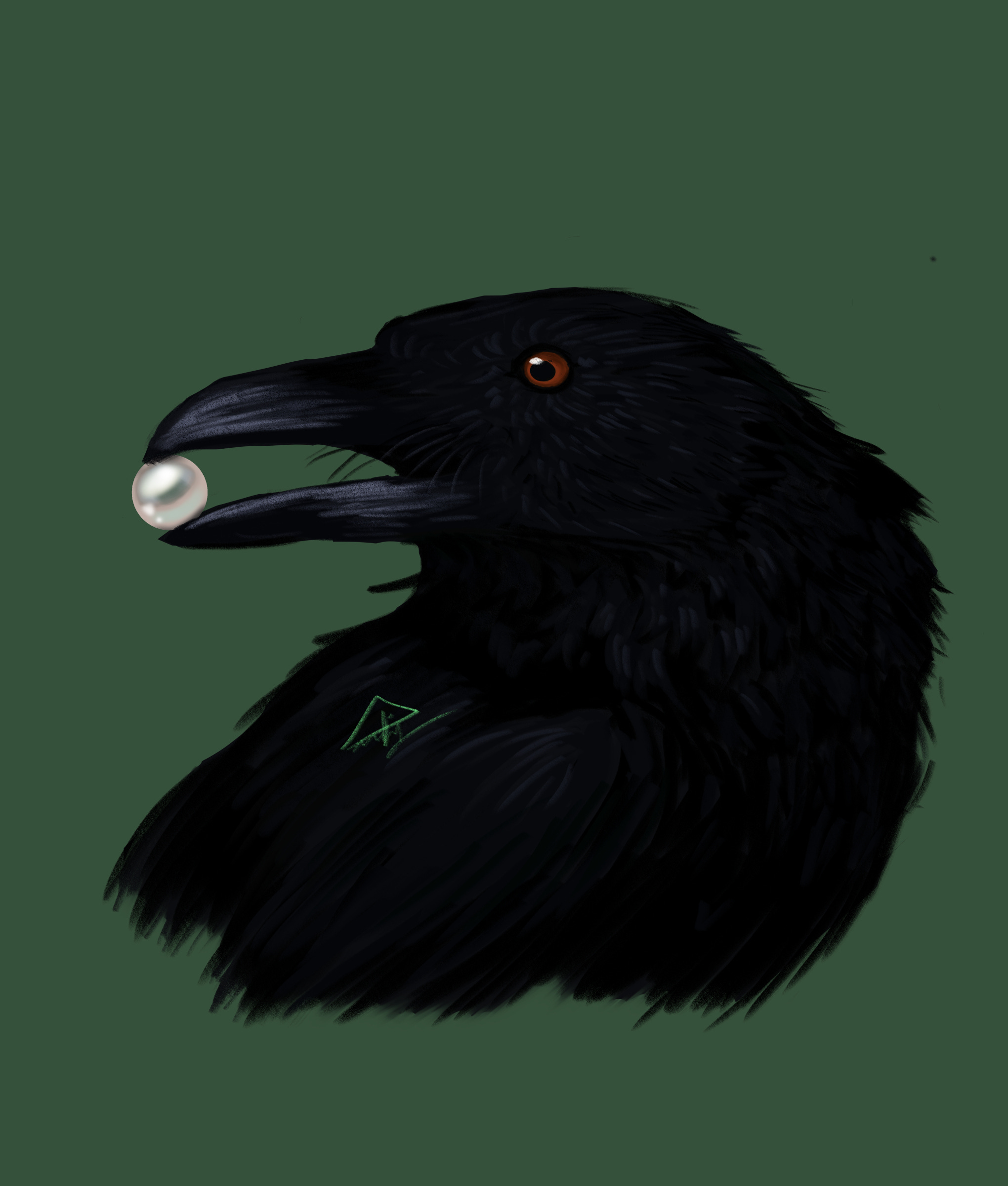
Where to find it and my experience:
Where there are people, there are Ravens (usually). Depending on where you live in California, you might have a high chance of seeing Ravens or live in an area where they rarely make an appearance[2]. Ravens can be found all over California in open and forested habitats[3]. So if you find yourself in an open landscape or a city and you look up long enough, you’re likely to see them. However, they are often mistaken for crows.
Do you know the difference between a crow and a raven?
Looking up in the sky without a frame of reference, it can be hard to separate the two; however, there are multiple ways.
For one, Ravens are far less social than crows and are less likely to congregate in large groups[1]. You typically see between 1-3 at a time unless there is a large food source nearby[1][4].
Ravens also have more slender silhouettes and long wedge-shaped tails[1].

If you catch them on the ground, you might notice they are big, probably bigger than you think. With an average wingspan of 3.8 feet —compare that to the American Crow’s 2.9 ft to 3.3 ft average wingspan— the Common Raven is the largest songbird in the world[3][4].
Ravens are pretty common where I grew up in San Diego, especially within the city. I would spot them on the coast, mesas, cliffsides, sage-scrubland, and downtown. One benefit of California is the large diversity of environments in close quarters, and Ravens are quick to take advantage. However, they aren’t everywhere.
When I moved to Monterey, California, I almost never saw them. My partner, who grew up there, could never recall having seen them even once (He was very surprised to learn how big they are). I even wrote about it in college, theorizing it had to do with the large population of crows in the county. Even now on iNaturalist, there are only 197 research-grade observations compared to Santa Cruz’s 823[5][6].
Why do you think there is such a huge difference in Raven populations?
Interesting population fact and a complicated conservation relationship:
Ravens are smart, complex, and dynamic animals. Maybe in part due to their close proximity to humans, the relationship between our two species hasn’t always been positive. Did you know in the state of Alabama, ravens are extinct? In the entire state, there are zero iNaturalist observations, and the last record of their presence was from over 110 years ago[11][13]. This was because of a mass campaign to eradicate them using poison, hunting, and trapping in the 1800’s[11]. Overall, Ravens have disappeared from most of the Eastern and Midwestern United States, largely due to habitat loss and a decrease in overall resources, although things are slowly improving as time goes on and hunting decreases[11][13]. At one point, there seems to have been a breeding program for Ravens in Arkansas and Alabama, although I’m struggling to find further information[1].
While in the East populations have had their struggles, the opposite is true for the West. In Idaho, over a period of 40 years, the Raven population increased 5-fold[12]. Over the same period in the Mojave Desert, the population has increased 700%[15]. However, these populations are so large they are creating a different kind of problem. Ravens are generalists and will eat almost anything that is palatable and accessible, and don’t have any reservations for endangered species[12][15]. They have been known to prey on sensitive species such as the Desert Tortoise, California Least Tern, Greater Sage Grouse, the Western Snowy Plover, and the San Clemente Island Loggerhead Shrike[12][15][16]. Ravens also have conflicts with famers having been known to take produce and hunt young livestock[16].
This has led to a call for population control, which varies from hunting to reducing access to human-provided food sources[12][16].
Today’s Art:
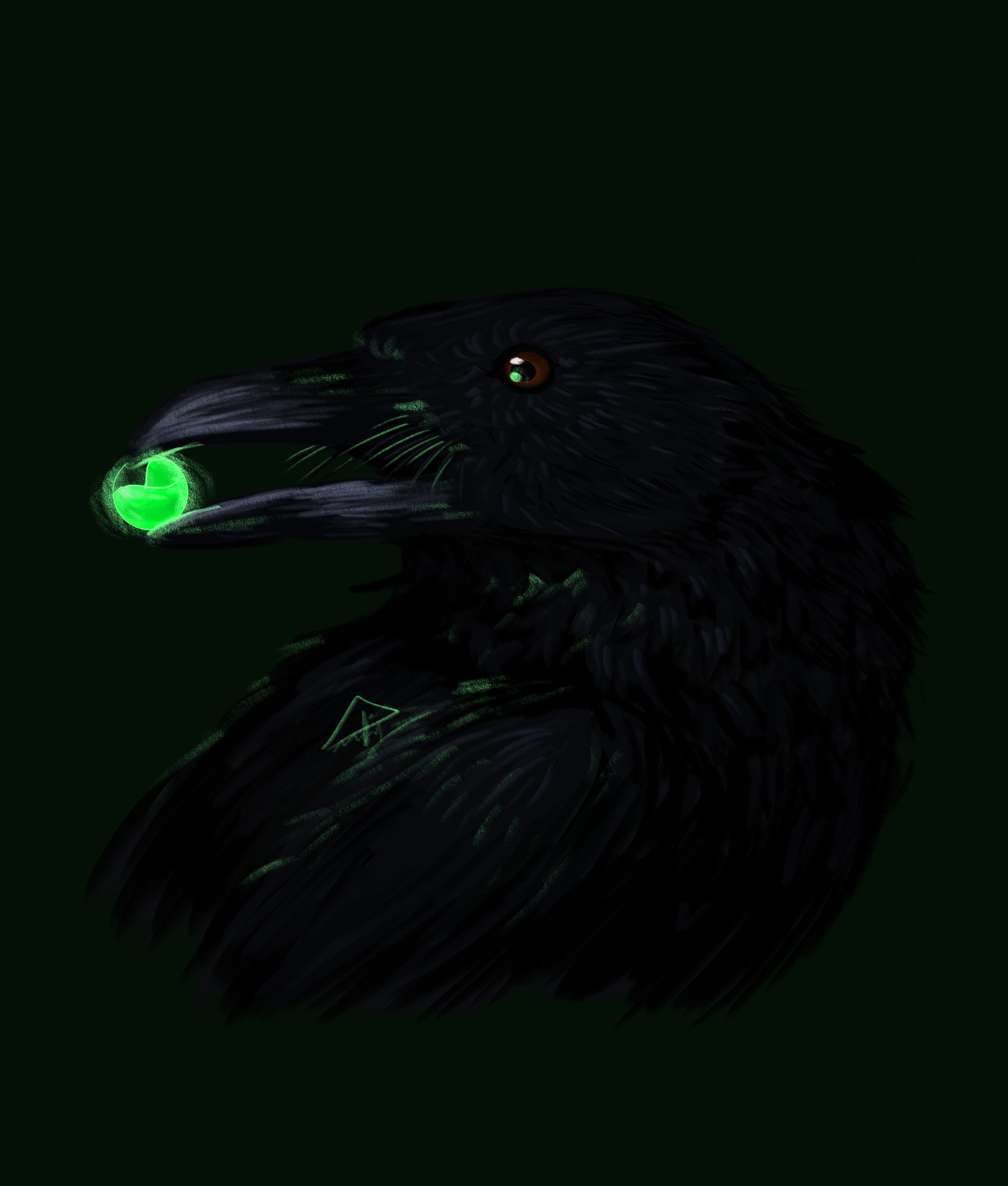
Today’s drawing was done in Clip Studio Paint, and it took me a little over 2 hours total. This is the kind of digital painting I have a lot of fun with, where things can start looking kind of weird, but you just keep adding layers and hope! I’ve also been thinking. Since I have a habit of getting creative with color and design here, despite the educational focus, maybe I should offer a more focused vision. So this drawing actually comes in a pair. This more realistic lighting, and an alternative dark one where I was having fun with color. However, I couldn’t help but add a little something, so the day Raven is holding a pearl instead of a red berry like the reference image.
After downloading it on my phone to send to my sister, I’ve also been reminded of one of the most important rules when creating art online: test your colors. While it still looks cool, on my phone the feathers look almost completely black!
So please, let me know: how does it look on your guy’s end?
Also stay tuned, because I recorded a Speedpaint for both. I’m still working on editing, but I’m hoping to get it out soon!
Dark version:
Sources and more places to read here:
The committee on classification and nomenclature of the American Ornithologists’ Union. The A.O.U. Checklist of North American Birds. 1983. 6th ed., Lawrence, Kansas, American Ornithologists’ Union, pg. 511-512.
https://www.sciencedirect.com/science/chapter/bookseries/abs/pii/B9780123808967000046
Jackson, Jake. Myths & Legends: Classical Greek, Celtic, Norse, Chinese, African, Native American & More. Metro Books, 2013.
https://www.nlm.nih.gov/nativevoices/exhibition/healing-totem/totem-stories/raven-and-the-sun.html
https://thebamabuzz.com/ravens-disappeared-from-alabama-110-years-ago-will-they-come-back/
https://www.audubon.org/magazine/10-fun-facts-about-common-raven
Thank you. I've always wondered how to tell the difference between a raven and a crow.
I live in San Diego County along the I-15 corridor in north county. On any given evening you can see groups if crows join up with a long stream of northbound crows as the commute home to the large roost located northeast of Escondido. In the morning you can see the reverse as crows head southbound to the "jobs."
Gorgeous illustrations! It’d be so cool if one day you painted a version that’d hang on the wall and selectively glow in the dark at night.
I’ve always loved ravens for how smart and playful they are.