
Raccoon
Procyon Lotor - California Native of the Week
First, I want to thank everyone who voted on the California Native this week! Today we will be discussing the Racoon! If you’d like to help choose next week’s California Native, then please check out the poll at the bottom of the article.
Common Raccoons are clever, grabby, and can be cute when they want to be. They are part of that group of animals that, even if you know nothing about animals, you can easily identify. Despite the fact that they are Nocturnal, they’re very well known and interact with humans semi-frequently, even if it’s by accident.
Raccoons are omnivores, meaning they are not picky about what they will eat. While we know them as scavengers, they are also notable foragers and hunters[10]. They have been known to eat insects, snakes, fish, small mammals, frogs, and a great diversity of plants[6][10]. In an ideal situation, they are hunting near a water source where they can dunk their food before eating[6].
Where to find it and my experience:
As the name implies, the Common Raccoon is quite common across North and Central America[10][8]. There are even populations across Europe due to purposeful and accidental introductions[8]. In California, they are concentrated in forested, coastal, and urban areas[3][8]. Because of their Nocturnal nature, you are most likely to spot them in cities or neighborhoods, where they have less foliage cover to hide. As long as it has food and a water source, a Raccoon is likely to be nearby.
I’d seen Racoons all over California when I grew up. My most interesting encounter with the chunky mammals was at college, in Monterey Bay. I was setting up hot chocolate and blankets at about 3 in the morning on the grass lawn of my college campus. A few friends and I were going to watch the blood moon that night. The sky was clear, the moon full, and the courtyard empty; it was a perfect night for it. I started setting up early because I wanted to be sure all of my attention would be on the moon once the event started.
When I scooted away from the last edge, I had to straighten on the blanket and plopped down to grab my thermos full of hot chocolate. I saw eyes staring at me. With the light of the moon, I recognized it as a Racoon pretty quickly. We stared at each other for a bit, neither knowing exactly what to do with each other. I try to gently shoo it off with a wave of my hand and a shuffling of feet, but it only backs away a couple of inches at most. I look down for a second to grab my phone. I had to tell someone, take a picture, or even encourage my friends to get over here faster. When I looked up again, the loner wasn’t alone anymore. 3 Raccoons stared me down, and I watched in horror as 2 more ambled closer out of the dart. I was frozen. Sure, I was taller than them and stronger in a hand-to-hand struggle, but I wasn’t confident that 5 racoons couldn’t take down a college girl with a heavy thermos as her strongest weapon. One brave one, the first one, took a few slow but confident steps to the edge of the blanket. It even got one paw on top of it before they scattered at the presence of one of my friends arriving with a bag of snacks.
Remember, no matter how cute they seem, never feed wild animals, especially not ones with the ability to open doors and bags by themselves.
Interesting Taxonomy facts and Historical record:
Raccoons apparently were hard for European scientists, colonists, and explorers to define. When Carl Linnaeus gave the Raccoon its scientific name, he lumped it in the same genus as bears, Ursus, in 1758[6]. It was reassigned to its current genus, Procyon, by Johann Karl Wilhelm Illiger, with changes coming in 1815, two years after Illiger’s death[6][7].
Captain Cooke may have mistaken another animal as a Raccoon [1]. Coming from his voyage journals, between 1708-1711, he claimed Racoons were the most abundant animal on the island chain Tres Marias.
“Of the animals, the racoon was the most plentiful. It has a large black eye, whiskers and nose like a pig, tail and feet like a rat, a brownish fur on his back, and a white belly.”
I don’t know about you, but that doesn’t sound like the raccoon that I’m familiar with.
It even comes accompanied with this illustration, and that is definitely not a Raccoon[1].
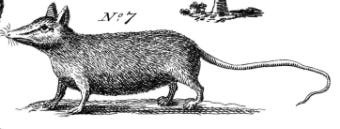
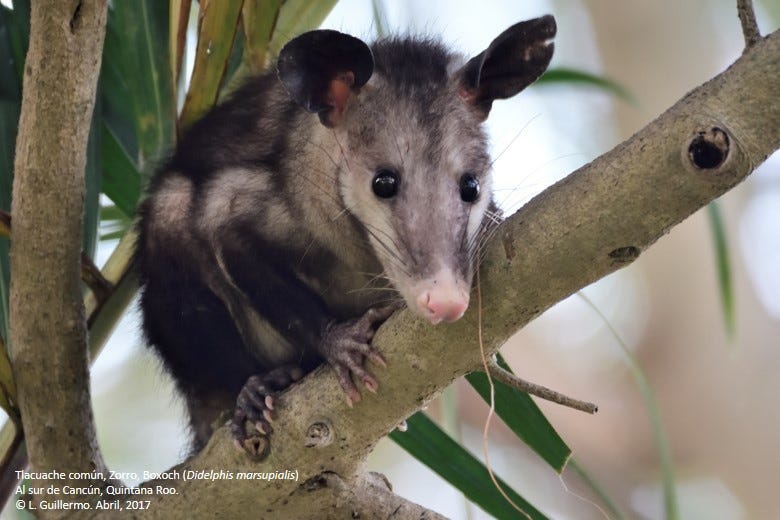
To be fair to Captain Cooke, Tres Marias does have an endemic species of Raccoon, but in appearance, they aren’t too far off from the ones we see on the mainland Americas. Instead, I think he saw some type of opossum, my guess is a Southern Opossum[9].
Today’s Art:
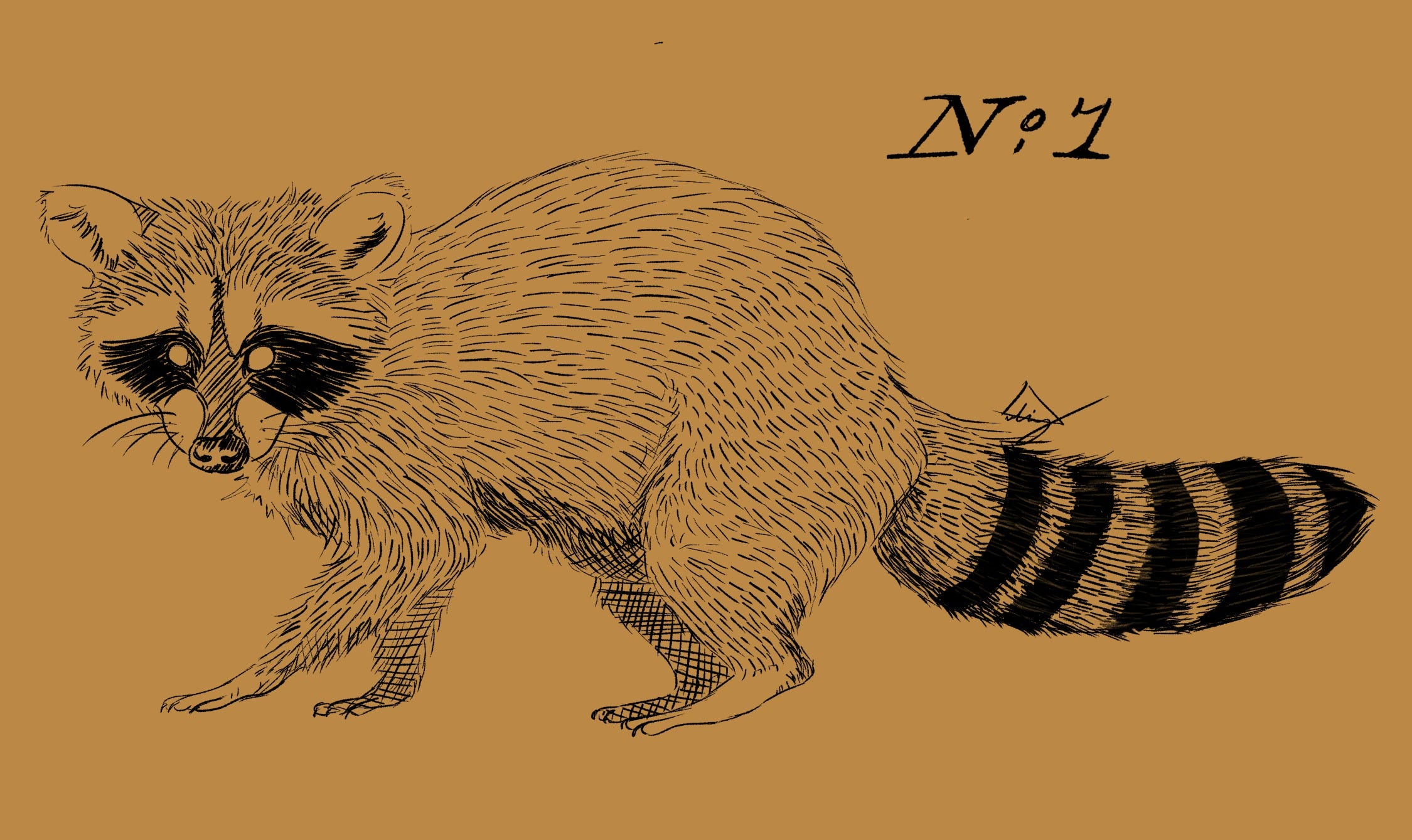
Once again, my artistic endeavors have slowed me down more than I anticipated. The original drawing I did was in pencil, but I’m a bit under the weather and cannot recall where I stashed my sketch book. So, I tried to push out a raccoon drawing as quickly as I could, so this article didn’t come out too late in the day.
Inspired by Captain Cooke’s records, I figure I’d try to draw in a similar fashion. As it turns out, it wasn’t as quick as I had initially envisioned, but I was having fun and was committed. This piece was drawn in Clip Studio Paint using the textured pen brush. Almost everything is drawn with straight line strokes and cross-hatching, so my fingers ache.
Sources and more places to read here:
https://gutenberg.org/cache/epub/78004/pg78004-images.html
https://www.knowyourmammals.com/mammal-identification/california-raccoon-procyon-lotor-psora/
http://www.naturemappingfoundation.org/natmap/maps/ca/mammals/CA_raccoon.html
https://www.biodiversitylibrary.org/item/61439#page/10/mode/1up
The Long and Fascinating History of Raccoons in North American Culture, From Symbols to Pets to Dinner | Smithsonian Voices | Smithsonian Books Smithsonian Magazine https://share.google/nYgzyPXV8qzucsSIc
Caire, William; Tyler, Jack D; Glass, Bryan P; Mares, Michael A. Mammals of Oklahoma. 1989. 1st ed., University of Oklahoma Press, p. 310.
https://en.wikipedia.org/wiki/Johann_Karl_Wilhelm_Illiger
https://www.inaturalist.org/observations?captive=false&quality_grade=research&subview=map&taxon_id=41663&verifiable=any
https://www.knowyourmammals.com/mammal-identification/southern-opossum-didelphis-marsupialis/
Jones, Knox J; Armstong, David M; Choate, Jerry R. Guide to Mammals of the Plains States. 1985. University of Nebraska Press, p. 267.