
Mule Deer
Odocoileus hemionus - California Native of the Week
In the lawn-blanketed and road-carved landscape that we call the United States, deer are often considered a nuisance. They eat crops, run into conflicts with cars, and are popular hunting targets. In North America, we have six species of deer, and today I will be talking about the Mule Deer or Odocoileus hemionus[3].
Mule deer can be easily identified by their large ears and black-tipped white tails. In winter, they are greyish brown, but develop a lovely reddish brown coat in the summer. When they graze, they are not picky, having been recorded to eat from over 600 plant species, cultivated, non-native, and native included[2].
Where to find it and my experience:
Although this series is about California species, when it comes to Large Mammals across North America, Mule Deer outnumber the rest[5]. This is true, even though they are found primarily in Western regions in North America[5][6]. So, no matter where you are on the western side of Turtle Island, you can find them in fields, forests, deserts, and mountain ranges. They are also crepuscular, meaning you are most likely to spot them during Dusk and Dawn.
Here in California, we actually have six subspecies of mule deer, and which one you come across depends on where you are[1]:
“O. h. californicus - California mule deer (Westside of Sierra Nevada down to southcoast)
O. h. eremicus - Desert/burro mule deer (southwest California, northwest Mexico and Arizona)
O. h. fuliginatus - Southern mule deer (Southernmost California and Baja California)
O. h. hemionus - Rocky Mountain mule deer (Northwest California, western and central North America)
O. h. inyoensis - Inyo mule deer (Sierra Nevada, California)
O. h. columbianus - Columbia Black-tailed deer (Northern California and Pacific Northwest).”
— State of California, Department of Fish and Wildlife
If you are ever in Monterey, keep an eye on the hills, golf courses, and grass patches the further inland you move. Mule deer can often be seen grazing right next to roads, unafraid of the cars that meander by. While living in Monterey, I came across them quite often in Pacific Grove and Marina. They generally kept their distance from people and weren’t outwardly aggressive, although I would avoid certain paths when the males started growing in size and audacity in the fall.
Interesting Migration fact:
Although long-distance migration among large mammals in California is rare, some populations of Mule Deer do. Some herds in Mono and Inyo counties migrate between high and low elevation areas during the summer and winter months[1]. When Mule Deer migrate, they utilize impressive mental power. While other animals may follow sensory guides to follow routes — Starlings use the sun, Salmon use smell, Mallards use stars, etc. — Mule Deer primarily use detailed memory to retread their steps. These mental maps can be so detailed and accurate that deer can retread the exact same steps from migrations before[7].
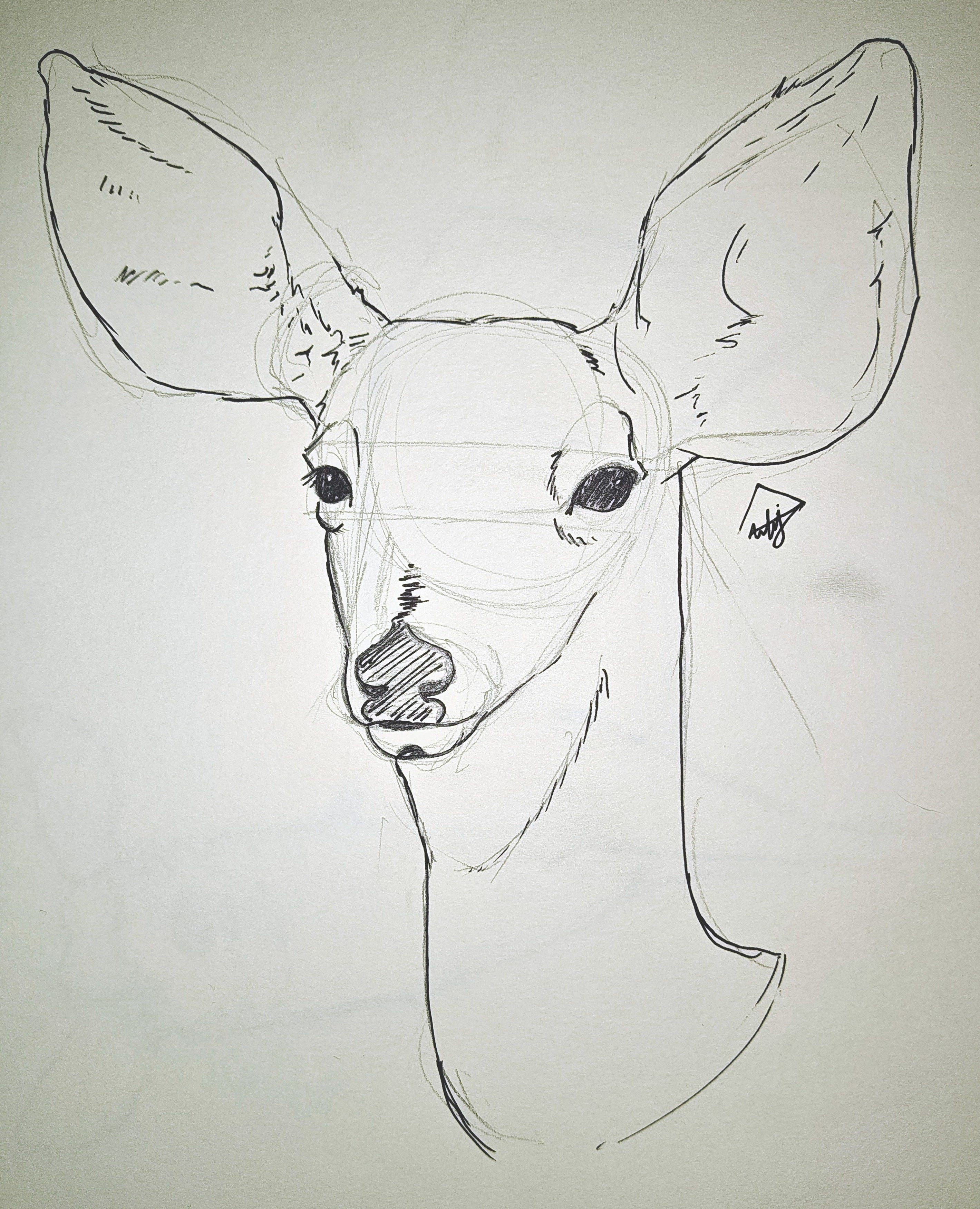
Today’s Art:
So I learned that drawing deer is not exactly my strong suit. This is the second attempt, and luckily, I was happy with it, but that first drawing had me feeling like I’d never put pen to paper a day in my life. Our Mule Deer subject was drawn using a 0.5 mm mechanical pencil and inked with a Sharpie S. Gel pen.
I’d love to hear from you guys! What California Native should I do next week?
Sources and more places to read here:
https://wildlife.ca.gov/Regions/6/Mule-Deer/Natural-History
Jones, Knox J; Armstong, David M; Choate, Jerry R. Guide to Mammals of the Plains States. 1985. University of Nebraska Press, p. 312.
https://wildlifeinformer.com/deer-in-north-america/
https://www.interestinganimals.net/mammals/california-mule-deer/
https://www.researchgate.net/profile/R-Bowyer/publication/272681670_VARIANCE_IN_SURVIVAL_OF_YOUNG_MULE_DEER_IN_THE_SIERRA_NEVADA_CALIFORNIA/links/54eba5ae0cf2ff89649e1ba6/VARIANCE-IN-SURVIVAL-OF-YOUNG-MULE-DEER-IN-THE-SIERRA-NEVADA-CALIFORNIA.pdf
https://www.inaturalist.ca/taxa/42220-Odocoileus-hemionus#map-tab
Goldfarb, Ben. Crossings: How Road Ecology Is Shaping the Future of Our Planet. 2023. W.W. Norton & Co., p. 103.
https://www.jstor.org/stable/41712705
https://www.biodiversitylibrary.org/page/28436613#page/23/mode/1up
https://www.biodiversitylibrary.org/page/28092436#page/143/mode/1up
https://www.nbclosangeles.com/news/local/la-county-counsel-catalina-island-mule-deer/3856704/