
Western Columbine
California Native of the Week
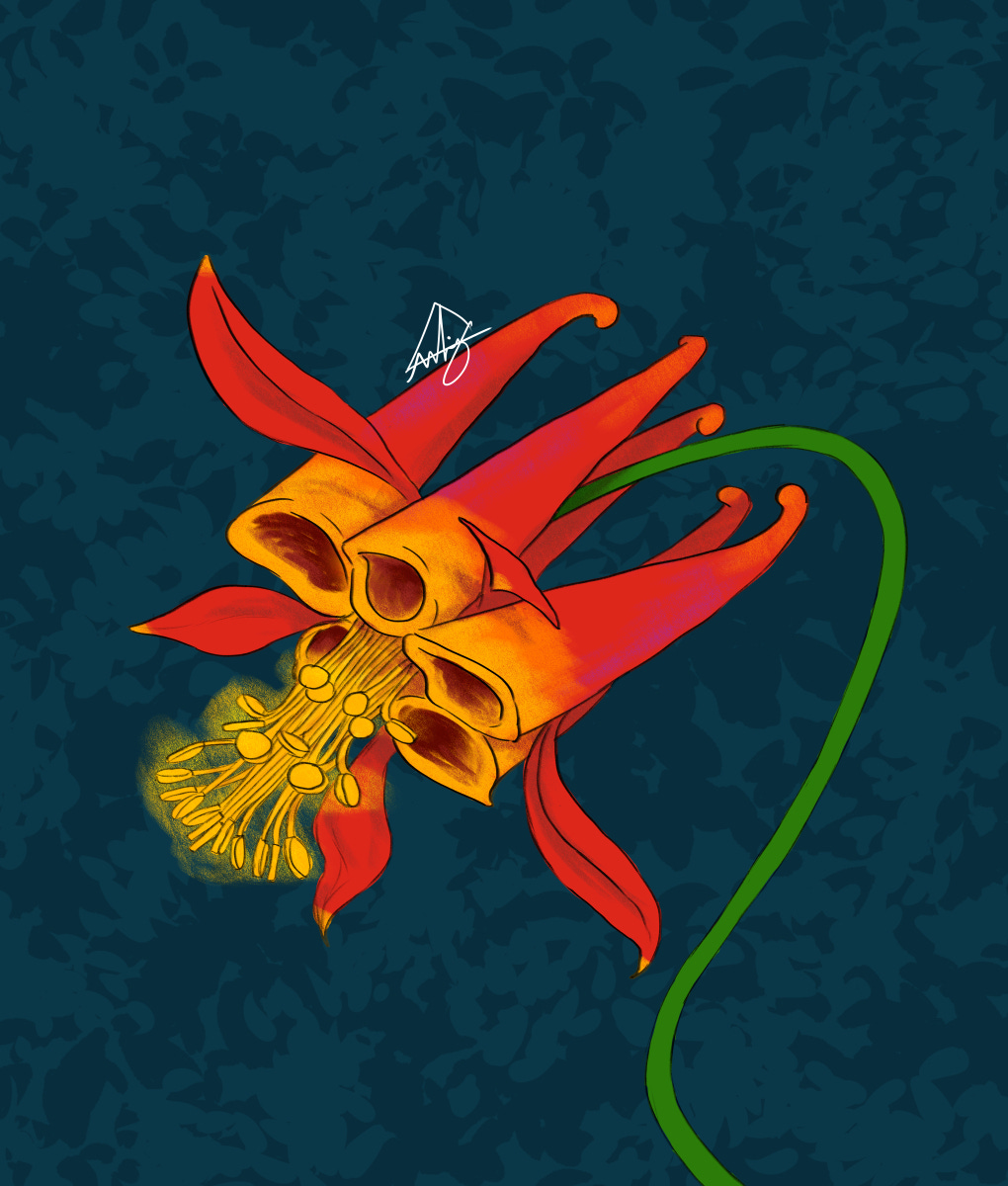
Describing a Western Columbine to someone who has never experienced it themselves and without a visual reference is quite a fun writing challenge. With a bouquet of downward-facing golden stamens, bright red cone-shaped petals (spurs), and a love of water, it would slot itself nicely on an alien planet. It’s not alien, though, and is a wildflower that can be found up and down the state of California, so long as it’s sufficiently moist. Butterflies and Hummingbirds are particular fans, as they have the ability to reach the nectar with little struggle. However, according to a record by T.D.A. Cockerell, he saw a bumblebee steal nectar by splitting a spur from the side[3].
Where to find it and my experience:
Aquilegia formosa can be found as far south as Baja California, and as far north as Alaska[7]. In California, its presence is relatively common, despite its odd appearance; you can find them almost anywhere in the state, except for the deserts of the southeast and the central valley[6][1]. They have a preference for woodlands —likely because their affinity to hold water— being found in a range of conifer, wetland, and fir forests[1]. They typically bloom between May and August, depending on the variation in your area[8]. In California, the range seems to be from March to June[8][6].
I’ve come across Western Columbines quite a few times, including Lassen, some Riparian spots in San Diego, and the occasional trail in San Jose. Most recently, I spotted patches growing along trails in Big Sur while climbing up to Buzzards Roost, and made choosing the Native of the Week a bit easier.
Interesting Taxonomy fact:
The genus Aquilegia has a dual Latin meaning. Aquila means eagle, which references the flower’s spurs, which have a claw-like shape; aquilegus means water-drawer, which references the plant’s desire for moist environments[8].
Today’s Art:
Today’s Illustration is done in Clip Studio Paint. I sketched it out, lined, and colored all in the program, which felt great, as I was struggling with hand-eye-tablet coordination for a while. I’m also trying to play a bit more with adding varied colors of the same value in a space, like the blue in the red petals. I’m having loads of fun with these illustrations, but I may need to take a break on color, as it seems to be consistently making my submissions come out late. So there may be more line art moving forward.
What weird flowers have you seen on the trail?
Sources and more places to read here:
https://www.biodiversitylibrary.org/page/32139013#page/175/mode/1up
https://www.biodiversitylibrary.org/item/222519#page/1/mode/1up
https://ucjeps.berkeley.edu/eflora/eflora_display.php?name=Aquilegia+formosa
Philip A. Munz and David D. Keck. A California Flora. University of California Press, 1968. Pg. 104-105.