
Sticky Monkey Flower
California Native of the Week

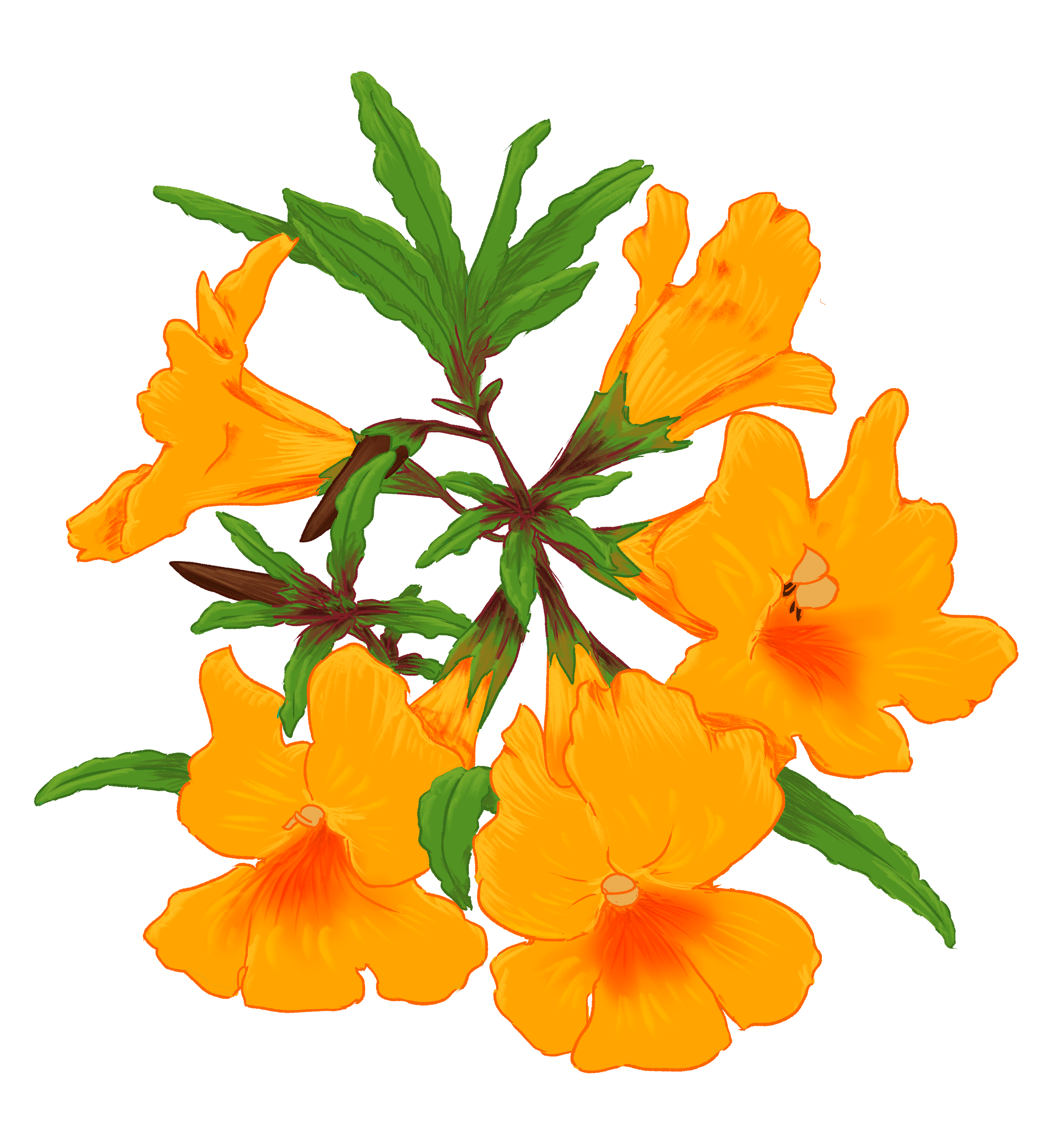
Sticky Monkeyflower, Orange Bush Monkey, or just Bush Monkeyflower, however you call it, when you see it, you might be immediately struck by its blooms. The plant grows quite tall, and when it blooms throughout the year, it can be dotted with orange, red, white and yellow flowers along the entire length of its branches[4][6]. They are also notable hosts for the variable checkerspot[3].
Where to find it and my experience:
Sticky Monkeyflowers grow up and down the entirety of the California coast, some areas in the central valley, northern California mountain ranges, and southern parts of Oregon. You are most likely to find them in rocky places below 3000 feet of elevation. If you are looking for them, they can be found in a variety of ecosystems, including: Chaparral, Foothill Woodlands, Redwood Forests, Northern Coastal Scrub, and Northern Oak Woodland[1][3][4].
I’ve come across them before in San Diego in chaparral forests in south county, where it does have a historical presence. Interestingly, there is no record through I-Naturalist, so if you live anywhere south of Los Angeles, or visit, it seems like there is a need for more plant observers. Right now I’m trying to grow some, but the saplings that sprouted might actually be some yarrow that snuck into the plugs. Time will tell.
Interesting Taxonomy fact:
Part of my plant research includes using some old science books I have, primarily, to get information on historical location, and compare any taxonomic changes. At first, I struggled for a bit to find Sticky Monkeyflower in the book A California Flora by Philip A. Munz published in 1968. In the book, the flower exists under the genus Mimulus rather than Diplacus. It turns out that in 2012, with the assistance of DNA barcoding, the genus, Mimulus, went from being one of the largest species groups in western North America to only containing seven today[2].
Today’s Art:
Today’s art work, is more fully fledged than my typical sketch that I upload here and I hope this can be something I can do more often; to occasionally be able to drop a fully illustrated piece next to sketches I do weekly. I created this digitally using the program Clip Studio Paint and my old Wacom tablet. I’m hoping I can increase my rendering skills this year and pieces like this are going to help me do that!
Sources and More places to read here:
Munz, Philip A. A California Flora. 1959. 4th ed., Berkley, California, University of California Press, 1968, p. 624.
Wikipedia Contributors. “Mimulus.” Wikipedia, Wikimedia Foundation, 18 July 2025. https://en.wikipedia.org/wiki/Mimulus.
Wikipedia Contributors. “Diplacus Aurantiacus.” Wikipedia, Wikimedia Foundation 26 Jan. 2022.