
Sculpted Puffball
California Native of the Week
This is another throwback! The Sculpted Puffball!
I’ve written about this geometric mushroom before, and this week, I felt like drawing it, thus it is our California Native of the week. If you’d like to read the original article check it out here. Also I've made sure to find out more information so I'm not just rehashing the same thing, and I even answered a question I had the first time.
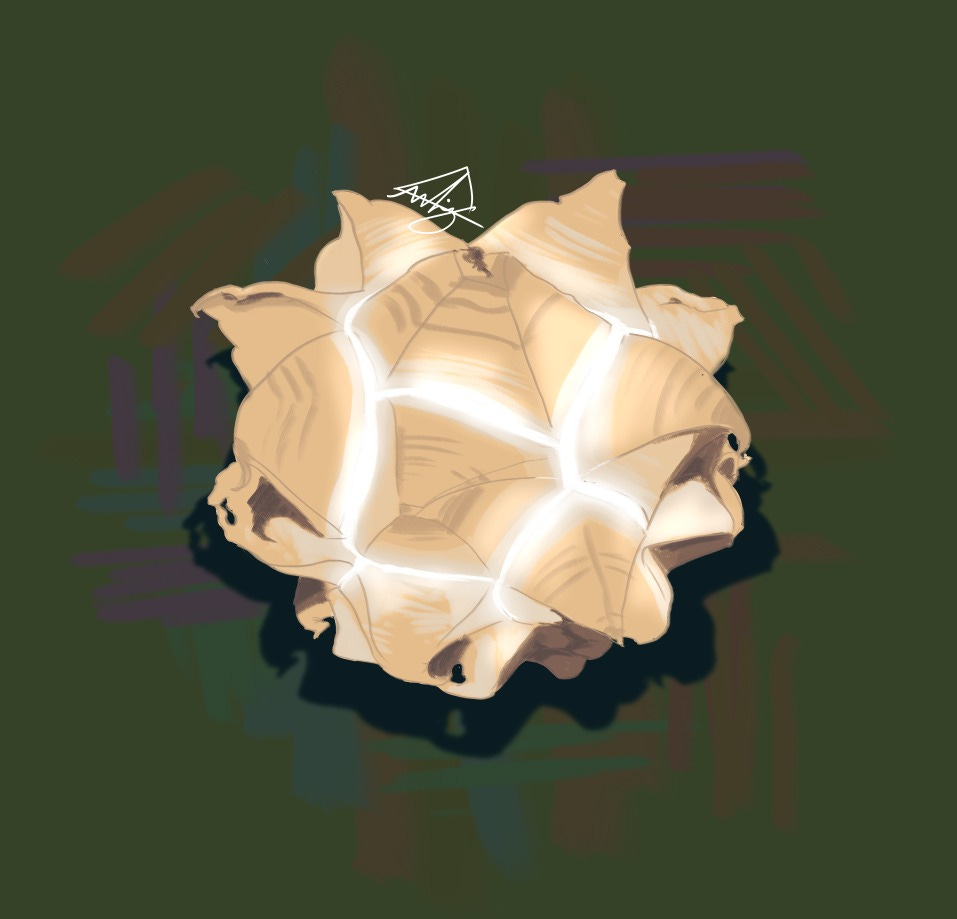
The Sculpted or Sierra Puffball is a geometrically structured mushroom that ranges in color from yellow to white. If you are lucky enough to spot it early, you can actually eat it, but just like any other puffball, once the color starts to shift from white and it starts to sporulate, it's better to avoid it[1]. It's also important to be careful when identifying this species, if you want to eat it. They are similar in appearance to another puffball which is also edible, and the pinecone amanita, which is not[1]. I even spotted a misidentification on I-naturalist, and if you aren't careful you may end up eating the wrong one[9].
Where to find it and my experience:
The exact range of this mushroom can be a bit hard to piece together. Some sources say it is only found in the Sierra Mountains[1], while at the same time this species of puffball is said to be imperiled (endangered) in Alberta, Canada[2]. All the same, the most sightings seem to be concentrated in the Sierra Nevada mountains of California. The rest of the sightings are all over North America, mostly concentrated in mountain ranges[3]. On I-Naturalist, there is even one recorded observation in Russia[5], however I have my suspicions it may be a Sculptured Puffball instead, which is similar, but belongs to a different genus entirely. Actually, after researching this species more I suspect most of the Identifications I've seen have been mislabeled on I-naturalist [3]. If you happen to be, or know a mycologist, this is a cool mystery to check out and potentially correct.
My research group and I came across our first Sculpted Puffball at a fire break in Mineral, in a mixed conifer forest. We thought it was cool, took pictures and moved on. When we did some research later and found out it was in fact edible, we went back to harvest two medium ones to share. To me it tasted kind of bland, with a miasma akin to a dirty sponge, there was also a hint of something sour. Maybe, if it was seasoned differently I would have enjoyed it more. However, considering, no one finished the fruiting body we collected, we might have collected one that was leaning towards no longer being good. Another fun interaction is that this mushroom stayed weirdly cold for a really long time. I write a bit more about that experience in my other article, that I mentioned above.
Interesting Taxonomy fact:
The Sculpted Puffball and the Sculptured Puffball are different, despite very similar common and scientific names—Sculpted vs Sculptured and Calvatia sculpta vs Calbovista subsculpta[1][9]. This unfortunately made research a little confusing, but it is very important, as this may have an effect on what is actually recorded in observations. The best way to tell the difference is the size of the warts. The Sculpted Puffball has relatively large warty protrusions of a smaller number that can be almost half the length of the main body or more —although sometimes the warts curl into themselves or flatten— even in early fruiting stages[1][6]. The Sculptured Puffball, meanwhile, has much smaller, more numerous warts[1]. Both fruiting bodies appear in the Spring in Sierras, but the Sculptured Puffball is more common[1]. Another major difference is whether or not it has a rooted base; the Sculptured has one, while the Sculpted does not[9].Also both are lacking an identifiable bell shape and have stems that are short and are relatively uniform in thickness unlike the Pinecone Amanita[8].
Another fun note is that C.G. Lloyd in the Mycological Writings of C.G. Lloyd, refers to Calvatia Sculptum and other fungi as plants which seemed to just be a legitimate term for fruiting bodies at the time (1898-1905). He also laments that the specimen he received from Lake Tahoe, wasn’t as big as he would have liked[4].
Today’s Art:
Today’s art is based on a specimen I took a picture of in Lassen. In real life it was only slightly bigger than my hand. This image was created digitally, using Clip Studio Paint. I tried something new today, by employing gradient maps; basically I illustrated everything in black and white first and then colored it after using different colors on a gradient applied to different values.
Sources and more places to read here:
https://www.mykoweb.com/CAF/species/Calvatia_sculpta.html
https://explorer.natureserve.org/Taxon/ELEMENT_GLOBAL.2.1071326/Calvatia_sculpta
https://inaturalist.ca/observations?preferred_place_id=6712&subview=map&taxon_id=194565
https://www.biodiversitylibrary.org/page/55452886#page/231/mode/1up
https://inaturalist.ca/observations/82572643
https://plantiary.com/mushroom/calvatia-sculpta_243.html
https://www.gbif.org/species/165555173
https://www.inaturalist.org/observations/334397789
https://www.mykoweb.com/CAF/species/Calbovista_subsculpta.html