
Mountain Lion
Puma Concolor - California Native Series

Mountain Lion, Puma, Catamount, Panther, or Painter; whichever of the 40+ names you use for Puma Concolor, it’s likely you’ve heard of these North American large cats[3][6]. In most places, they almost feel like a legend: frequently discussed but rarely seen. There are many reasons for this from their shy behavior to their crepuscular activity[7][9]. They also travel far —up to 25 miles or more in one night— and due to this distribution, there are many subspecies that range in size, color, and behavior[1][3][7].
Where to find it and my experience:
Mountain Lions are found all over the Americas from Tierra del Fuego to northern British Columbia [4][2]. Historically, in the contiguous US states, but now, in the east, the only breeding populations persist in Florida, eastern Oklahoma, and maybe western Arkansas[2][4]. Here in California, sightings can occur almost anywhere, as this species is very widespread and travels far[4]. Despite this, Mountain Lions often go unseen by most. This is because they avoid conflicts with humans best they can and are masters of stealth[1][4]. It also helps that because they are largely solitary and have large territories, populations remain low and spread out[4]. You could go your whole life without seeing a Mountain Lion and have it living right next to you; later on I will talk more in detail about a mountain lion who lived 10-11 years peacefully in Griffith Park, right underneath the Hollywood Sign[5][7]!
Growing up in San Diego, it wasn’t uncommon to hear stories about Mountain Lions coming down from the mountains to pick off the occasional outdoor cat or dog. While this is something that does happen, I have doubts that it was at the frequency that was shared, as Mountain Lions often get a pretty bad rap[7]. I haven’t seen a Mountain Lion in person. I have spotted their paw prints though, and I think I’ve heard them. You might have too. Despite their large size, Mountain Lions are not technically Big Cats, and one of the things that separates them is the fact they can’t really roar[3]. Instead, they scream; the sound tends to range from aggressively high-pitched meow to dying woman. In the middle of the woods, that can be terrifying to hear, especially if you aren’t prepared for it. They do have other vocalizations which I’m sure I encountered myself. Have you heard any of these?
Misconceptions, Today’s Art and The Story of P-22:
Mountain Lions get a bad rap because they are large predators; however, attacks are rare, especially fatal ones. In the United States and Canada, there have been around 20-30 fatalities, and most have been children[3][8]. In California, there have only been 6 confirmed cases since 1890[8][10]. This doesn’t mean there is no risk to their presence, but it has largely been overblown. Even videos supposedly showing attacks are more often than not examples of escorting, a known Mountain Lion behavior where the cat will escort a threat away from their territory or cubs[8][10].
There are also worries about pets and livestock being attacked, but these interactions are also rare, but more common than human interactions[8][10]. Ironically, removing cougars from an area can increase rates of attacks because young mountain lions are more likely to engage in risky behaviors[8]. However, overall, Mountain Lions prefer wild prey such as Deer, Elk, and Porcupine[2][6].
Which brings us to the story of the subject for my illustration.
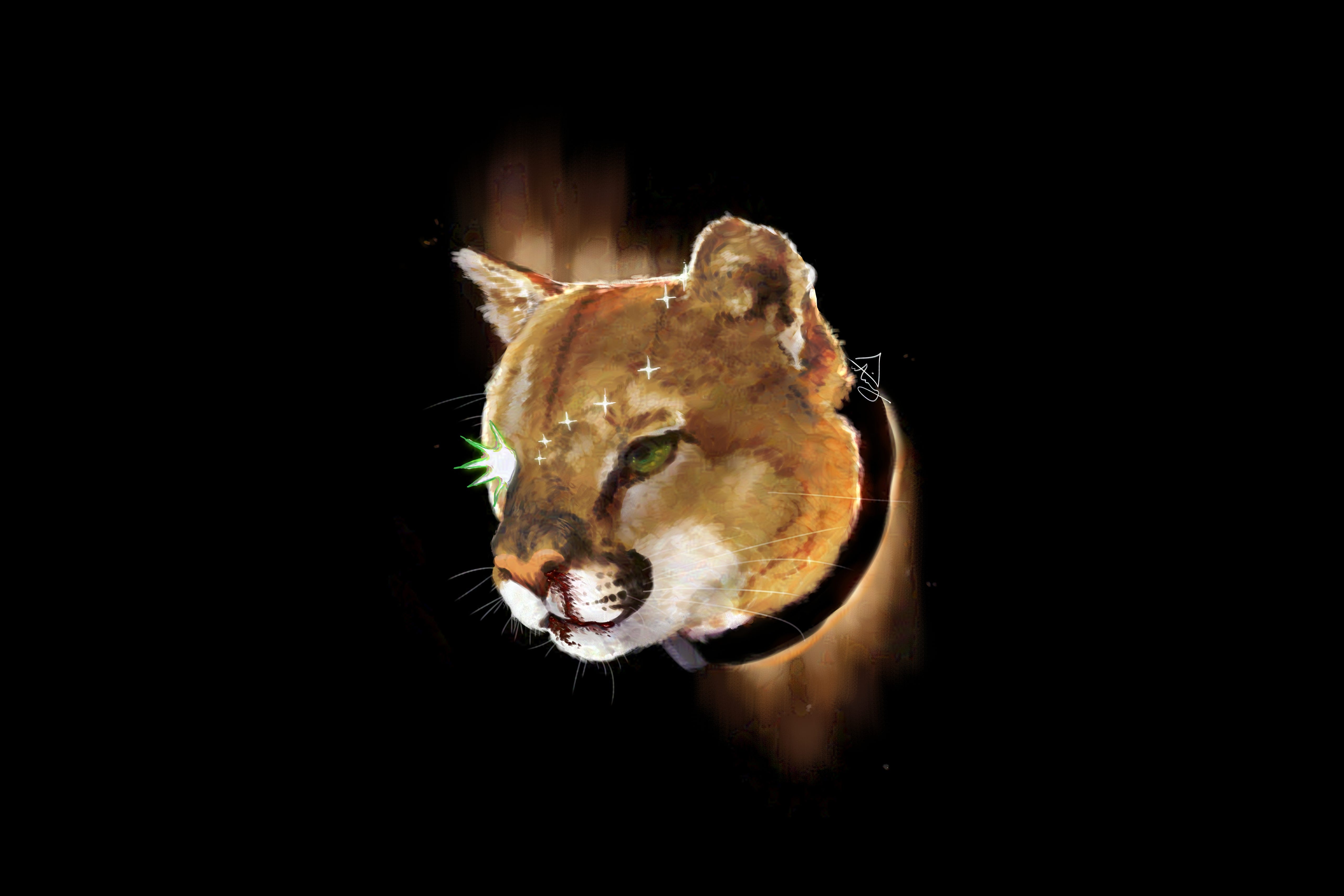
In August 2025, I was reading Crossings by Ben Goldfarb and learned about P-22, a Mountain Lion living under the Hollywood Sign. He lived a little over a decade with no conflicts with humans, walking along the same hiking trails. The unfortunate thing was that he was trapped. He had crossed two highways to reach what would become his final home in Griffith Park, a feat many mountain lions tried and failed to do. Despite his relative peace with humans and pets that frequented the park, he had little space. He had access to about 9 square miles of territory, compared to a typical male, which would have access to well over 200. Everything came to an end in 2022. P-22 attacked a dog on two occasions. When researchers went to investigate, they found that P-22 had extensive injuries —likely due to being hit by a car— such as internal organ damage, significant head trauma, and damage to his right eye. These injuries made it difficult for him to hunt his typical prey and likely led to his other afflictions, such as chronic weight loss and a parasitic skin infection. Due to the extent of his injuries, he was euthanized that same year[5][6].
When I first read the story, I cried. When I drew him, I tried to reflect his injuries in an artistic way, with the stars and then the blood trail from his nose. The constellation on his forehead is the Lynx, the closest I felt I could get to a mountain lion. On his neck is a GPS collar, and I tried to give an Aurora/flame ambiance around him. I wrote an article about my process that you can check out here:
P-22

I’ve been reading Crossings by Ben Goldfarb, and there are many stories that have moved me and made me cry so far. However, when I learned about the story of the mountain lion P-22, let's just say I felt an artistic frenzy. What started as a fun idea and testing out new brushes turned into a full-fledged piece I am immensely proud of, so I thought it wo…
Have you ever had an experience with a Mountain Lion?
I’m also curious about what you guys think about the story of P-22?
You can also support me on BuyMeACoffee where I have a Gallery of California Organisms, A shop with stickers, and exclusive behind the scene posts for supporters.
Sources and more places to read here:
Caire, William; Tyler, Jack D; Glass, Bryan P; Mares, Michael A. Mammals of Oklahoma,1st ed. 1989. Oklahoma Museum of Natural History Publication, p. 342-345.
Verts, B.J.; Carraway, Leslie N. Land Mammals of Oregon. 1998. University of California Press, p. 450-455.
https://thewildsource.com/the-many-names-of-puma-concolor-mountain-lion-cougar-panther-and-more/
Goldfarb, Ben. Crossings: How Road Ecology is shaping the future of our planet. 2023. W. W. Norton & Company. pg 138-140.
https://www.nwf.org/Educational-Resources/Wildlife-Guide/Mammals/Mountain-Lion