
Mallards
Anas platyrhynchos - California Native Series

Anas platyrhynchos is probably the most ubiquitous species I’ve talked about so far. You can find it basically anywhere that has a body of water here in California, and they aren’t too picky about the quality. The males are iconic with their bright yellow bills and iridescent green heads. Females are brown and spotted and have a gorgeous stripe of blue on their secondary feathers, a trait they share with the males. Mallards are a type of “dabbling duck,” meaning they don’t dive for their food; instead, they remain floating on the surface and tip their heads under the water searching for vegetation and invertebrates[1].
Where to find it and my experience:
Here in California, Mallards are present year round and can be found anywhere there is a fresh body of water[1][3]. Outside of California, Mallards can be found all over the US, although they are migratory in the southeast[1][4]. They can also be found Globally and have been introduced to Oceania and the Hawaiian Islands[4]. The next time you are out near a pond, river, or lake —artificial or natural— keep your eyes and ears open.
Growing up, Mallards were the most common duck I had seen and, for a long time, the only type I recognized. One of my favorite spots in San Diego was Balboa Park, and I distinctly remember ducks who enjoyed bobbing beneath the water jets of the fountain in front of the Science Center. They would be so obscured by the mist, at times, I thought they were weird decoys, so I would stare throughout the day, constantly turning my head towards the birds, hoping to see if they would fly away, and eventually they did.
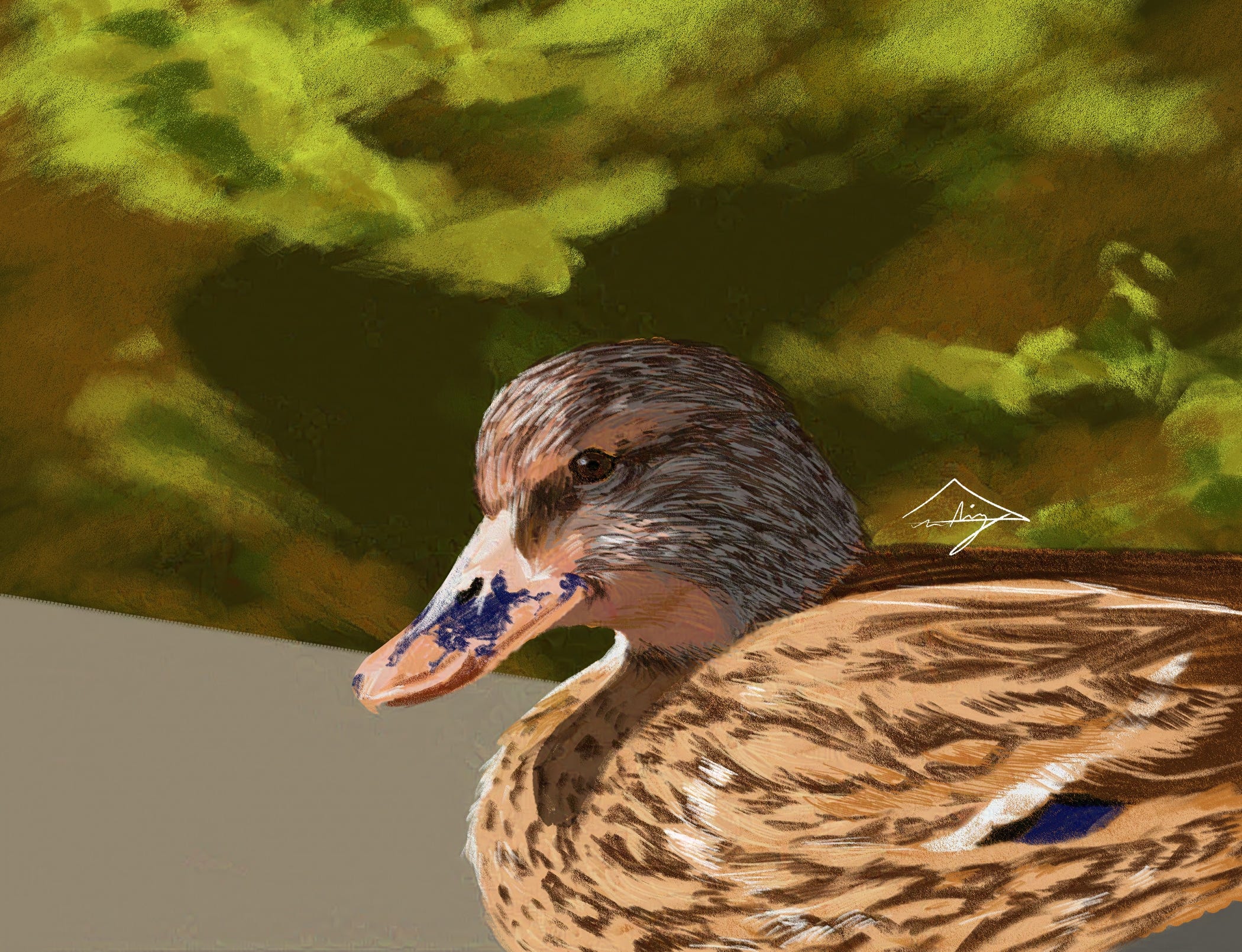
I also used to intern at the Chula Vista Living Coast when I was 17, and a lot of that work was caring for the birds. Roxie —the subject of the illustration— was a female mallard with Arthritis living in the aviary with other injured or unreleaseable shore birds. Her and her best friend, Hershey, would stalk the aviary, bullying birds missing eyes and toes for extra food, and what I could only assume was some kind of enjoyment. She also had an outdoor boyfriend. A wild mallard we named Duke who would come to visit her every single morning to look at her through the aviary fence. We thought she hadn’t noticed, but a few times she would intentionally carry food in her beak and park herself just out of his reach. As you can imagine, some mornings were full of distressed honks, but Duke always came back.
Interesting Population fact:
The reason you see mallards everywhere has a few good reasons: you may be misidentifying another species; mallards breed quickly in the wild; and the wild mallard is the ancestor to nearly all domestic ducks, so feral ducks tend to look very similar[2][5]. Mallards also freely crossbreed with many other species of duck, including: the American Black Duck, Mottled Duck, Gadwall, Northern Pintail, Cinnamon Teal, Green-winged Teal, Canvasback, Hawaiian Ducks, Mexican Duck, the Grey Duck , and the Pacific Black Duck[2][5]. This can be an issue for their conservation and the conservation of other ducks, as it is harder to track populations with all the interbreeding[2][6]. Mallards do seem to be declining, though; in general, dabbling duck populations are 10 percent lower than the average[2][5][7]. As to why, the research is still out, but a lot of the blame for bird declines in general has been tied to agriculture, climate change, and crossbreeding with domestic species[2][5][6][7].
Today’s Art:
For the art today, I was going for realism and illustrated a photo of a female Mallard I used to work with named Roxie. It’s digital, drawn in Clip Studio Paint. I don’t usually say how long the pieces took me, because I typically don’t pay attention, but I got a couple of questions about it. I’d say it took me about 3 hours…I’m not sure. I need to be better about recording my time.
Would you guys be interested in speed paints?
Shoutout!
I want to give a shoutout to Piper McNulty who is supporting the newsletter and helping me make this experience better for everyone.
If you’d like to help support what I do, I’d love it if you check out my BuyMeACoffee where you can donate once, buy some stickers, or check out a gallery of my photos of the plants, animals, and fungi of California!
You can also see my identifications and photos on I-naturalist.
If you are new to the newsletter, and would like to stay updated, and come with us on a Bug Hike, please subscribe to the free newsletter. We’d love to have you!
Sources and more places to read here:
The committee on classification and nomenclature of the American Ornithologists’ Union. The A.O.U. Checklist of North American Birds. 1983. 6th ed., Lawrence, Kansas, American Ornithologists’ Union, pg. 75-76.
https://www.audubon.org/magazine/solve-mallards-mysterious-decline-researchers-turn-hi-tech-trackers
https://www.audubon.org/news/mallards-are-everywhere-and-thats-great-wetlands