
Desert Cottontail
Sylvilagus audubonii - California Native Series

Despite a culturally notable pair of buck teeth, rabbits and their relatives —including the Desert Cottontail— are not rodents. Instead, they belong to a family called the Lagomorphs. California has a handful of species in this family, but today I’m focusing on Sylvilagus audubonii.
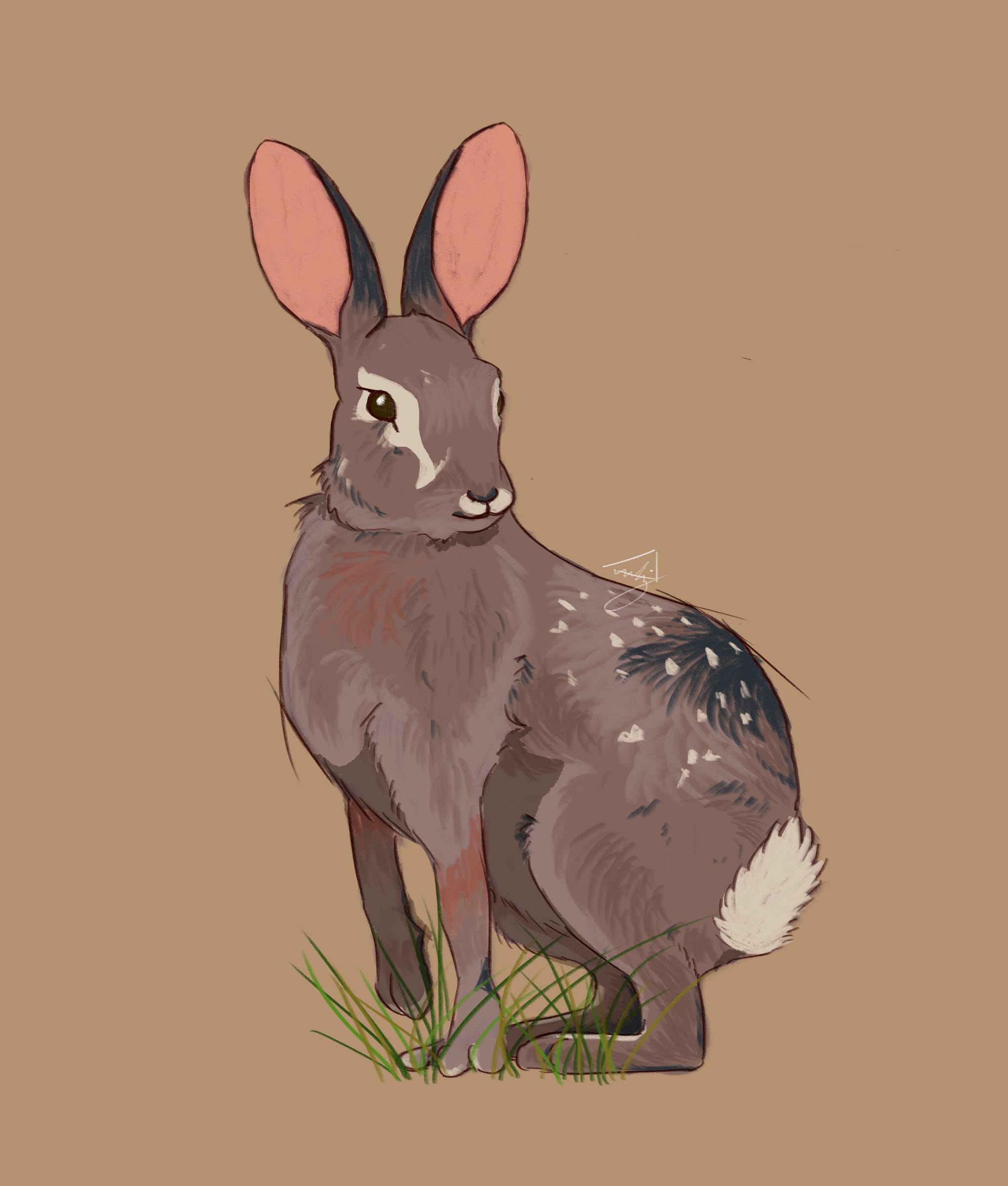
Like all Cottontails, Sylvilagus audubonii is best identified by the cotton-like fluff at the bottom of their tails[5]. They are paler than other rabbit species in the area, with small patches of black fur on their back and ears and reddish-orange fur on their chest[5]. However, some details in color can vary between subspecies, 4 of which are can be found in California[6].
Where to find it and my experience:
In California, Desert Cottontails are found pretty much anywhere but the dense forests of the north and high elevations of the Sierra Nevada [2][3]. This is because the food they primarily subsist on —grasses, shrubs, and low-growing flowering plants— is quickly shaded out in the dense gymnosperm-dominant forests of the north[1][4][5][7]. Compared to other rabbits in California, Desert Cottontails are actually more adaptable and occupy more niches, being found in Canyons, Deserts, Mesas, Coastal Sage-Scrub, and much more[1][2][5][6].
If you haven’t spotted one, you might just be looking at the wrong time. Desert Cottontails are most active during dusk, dawn, and nighttime[1][3][4][5]. However, this isn’t a hard-and-fast rule, and individuals do make themselves known during the day.
Growing up, the Desert Cottontail was a common occurrence in my local neighborhood. The housing development we lived in circled a canyon that was fenced off by a few concrete walls and long stretches of chain-link fence. Inside the canyon, there was a lot of vegetation, trash, and animals, including the Desert Cottontail, who passed through the fence easily. Outside of the canyon, the rabbits often wandered around eating any vegetation they could get their teeth on and avoiding rowdy kids and cars. My siblings, the neighborhood kids, and I would follow them for hours, creating these elaborate stories about their lives. Once we found a bone in our local park, and we were convinced it belonged to a desert cottontail. We even started a rumor that snakes were definitely in the Canyon and that’s why the bone was there; the snake just coughed it up. Now that I’m older, I’m sure it was odd to see a group of children whispering conspiratorially about monsters and snakes —that we were sure was 20 feet long— while gathered around what was likely an old chicken bone.
Although they didn’t realize it, rabbits were always a pivotal part of my childhood. From stories of Br’er Rabbit to Peter Cottontail to the wild cottontails who ran around outside of my home, there was always a sort of connection there. It’s a wonder I didn’t read Watership Down until I was in College, which became an instant obsession.
Interesting Temperature Regulation and Food web facts:
Compared to other Rabbit species in California, Desert Cottontails have the tallest ears, ranging from 2.3-2.7 inches in length[1][5]. This is because their ears are their primary tool for temperature regulation[5].
Also, Desert Cottontails are the preferred meals for many predators, including Coyotes, Hawks, Owls, foxes, snakes, and humans[5].
Today’s Art:
Today’s piece was done in Clip Studio Paint, and I got a bit more experimental with the colors. In reality, Desert Cottontails are much paler in color and a lot less purple in hue, but I had fun either way.
Sources and more places to read here:
Caire, William; Tyler, Jack D; Glass, Bryan P; Mares, Michael A. Mammals of Oklahoma,1st ed. 1989. Oklahoma Museum of Natural History Publication, p. 160-162.
https://www.inaturalist.org/taxa/43115-Sylvilagus-audubonii#map-tab
https://www.fs.usda.gov/psw/publications/documents/psw_gtr037/mammals/m028.pdf
Schmidly, David J. Mammals of Trans-Pecos Texas, 1st ed. 1977. Texas A&M University Press, p. 62.
Jones, Knox J; Armstong, David M; Choate, Jerry R. Guide to Mammals of the Plains States. 1985. University of Nebraska Press, p. 119, 122.
Miller Jr, Gerrit S; Kellogg, Remington. List of North American Recent Mammals, Bulletin 205. 1955. United States National Museum. Smithsonian Institution. p. 167-168.
https://www.biodiversitylibrary.org/item/254341#page/21/mode/1up