
Chaparral Dodder
California Native of the Week - Cuscuta californica

Going back home, equipped with more knowledge and awareness of ecology, is a surreal experience. San Diego is a biodiversity hotspot; a fact that evaded me for most of my adolescence, despite my lifelong biology obsession. Despite being surrounded by nature my whole life, environmentalism and ecology had felt like something distant, especially living in a large city. It’s part of the reason I started the California Native of the Week series. Now, after a half-decade of absence and a mind saturated with bio facts, I see it.
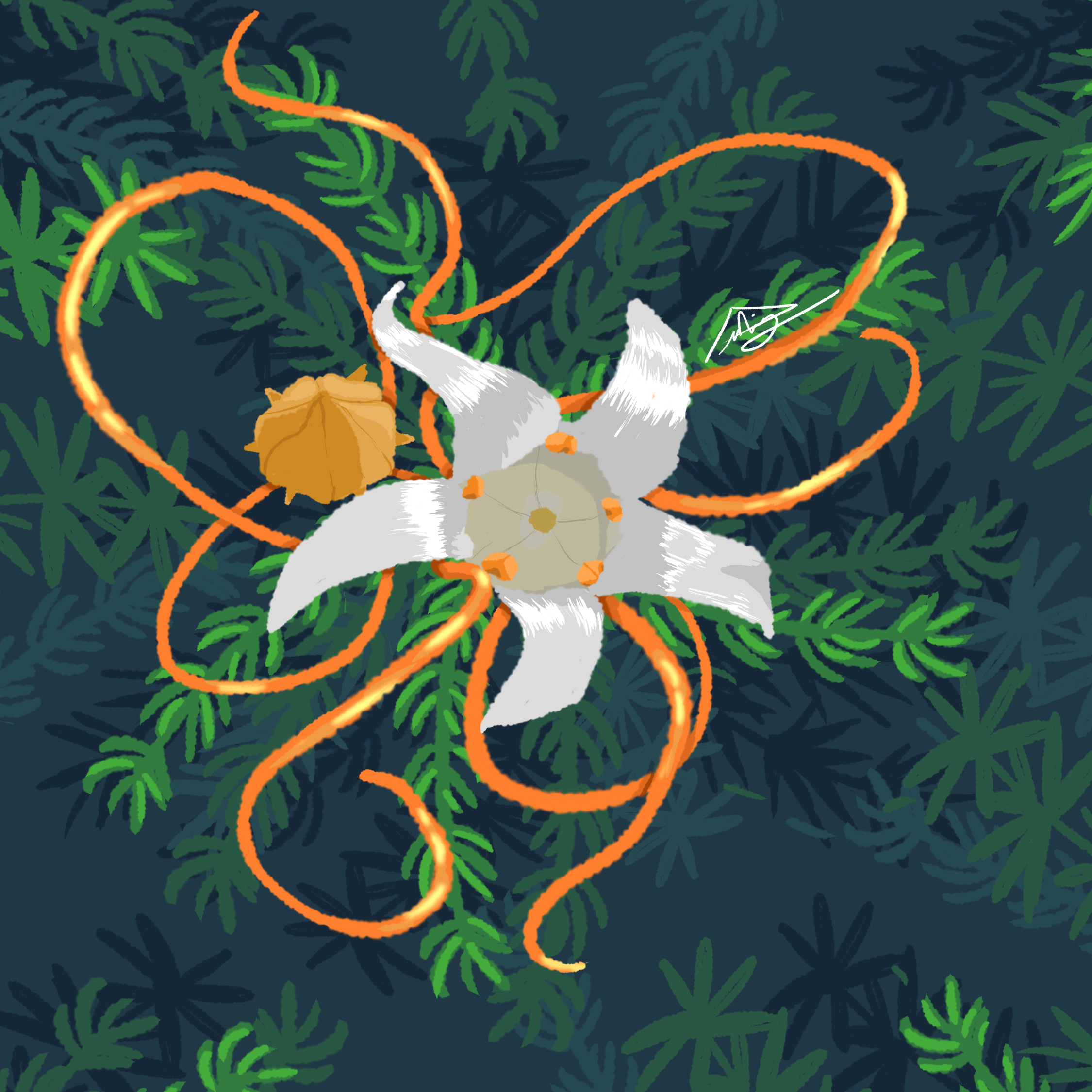
This week, I am talking about the Chaparral Dodder, California Dodder, or Cuscuta californica. Looking more spaghetti-like than plant, this parasite is always fun to spot. These orange vines are annuals, meaning they die off every year, so they don’t bother their hosts for long[1]. The first thing you might notice is that, despite being plants, they aren’t green. This means they cannot photosynthesize, so they need a host to survive[1][10]. While they technically can have leaves, they are rarely seen and appear as scales that grow close to the stem[1]. It has no roots, and when it does flower, the flowers are small and white[4]. Despite spending most of its life above the soil, it does seed normally; however, without other energy systems, it needs to find a host within a matter of days, or it will die[1][5][10].
Where to find it and my experience:
While back home for a weekend, I spent a good deal of my time driving in and out of Kumeyaay territory in Jamul. My family lives in East County, and the hotel my sister and I were staying in was out there. It’s an area populated with a smattering of houses, extensions of the Sycuan Resort, and undeveloped scrubland. This time of year, the hills are dotted with golden flowers and woody green shrubs. If you keep an eye out, you’ll notice at seemingly random intervals they are smothered in mats of orange string. Fortunately, I wasn’t looking at some abandoned construction equipment, but rather a California Native parasitic plant.
Chaparral Dodder can be found all over the Western United States[3]. In California, they make their presence known in almost every county[6][2]. California has at least 14 species of native dodder (I struggle to find an official number), so how do you know if what you’ve encountered is Cuscuta californica[6]? The best way to tell is to look at its host. Chaparral Dodder has a preference for sages and California Buckwheat, but they’ve also been spotted on Sand Aster, California Croton, and Deer Weed[1]. Look closely if you spot it, during the summer they start to open their tiny white flowers, and you may even spot some interesting seed eaters inside[11][12].
When I was in Lassen, I came across a type of Dodder, but I’m not sure if it was specifically Chaparral Dodder. If I could remember the host, that would help greatly.
Although parasites often get a bad wrap, it’s important to note that true parasites don’t want to kill their host, and dodder falls under this category. So if you see it, leave it alone. Dodder is just another part of the ecology of California.
Interesting Medicinal Use and Taxonomy fact:
Historically, the Kumeyaay peoples of San Diego and northern Mexico used Dodder that grew on Buckwheat to help with Black Widow bites[1][13]. Dodder as a genus seems to have a multitude of medicinal uses across different species, but I didn’t find much more on California Dodder[14].
Apparently, the name of the genus Cuscuta is derived from an Arabic word meaning “tangled hair,” but I’m not finding a lot of official confirmation[15][1][5].
Today’s Art:
Today’s art is all digital, done in Clip Studio Paint. Once again, I got into the zone, and this piece took me a few hours longer than I thought, which is why today’s post is on a Monday rather than a Saturday or Sunday. When I was starting the piece, I wasn’t sure how I was going to tackle the detail involved in a whole pile of string. To help with that, I decided to keep it simple with a lot more implied detail on the plants in the background, and a smaller mat of “string” in the foreground. I also wanted to have a bit of fun with color, since I feel like color theory is a constant lesson I am learning.
Sources:
https://naturecollective.org/plant-guide/details/california-dodder/
https://calflora.net/botanicalnames/pageCI-CY.html
https://plants.sc.egov.usda.gov/plant-profile/CUCA
https://www.inaturalist.org/taxa/57019-Cuscuta-californica/browse_photos
https://smmtc.org/plantofthemonth/California_Dodder.php
https://www.calscape.org/Cuscuta-californica-(Chaparral-Dodder)
https://calscape.org/search/?plant=dodder
https://ucjeps.berkeley.edu/eflora/eflora_display.php?tid=21422
https://www.nature.com/articles/nature25027
https://www.nps.gov/bibe/learn/nature/dodder-story.htm
https://www.cch2.org/portal/taxa/index.php?taxon=Cuscuta%20californica&formsubmit=Search%20Terms
https://www.biodiversitylibrary.org/page/34210024#page/51/mode/1up
https://www.academia.edu/411148/Native_American_Consultation_and_Ethnographic_Study_with_Kumeyaay_along_Highway_94_Cty_of_San_Diego
https://pfaf.org/user/cmspage.aspx?pageid=174
Munz, Philip A. A California Flora. 1959. 4th ed., Berkley, California, University of California Press, 1968, p. 466.