
Cedar Waxwing
Bombycilla cedrorum - California Native Series

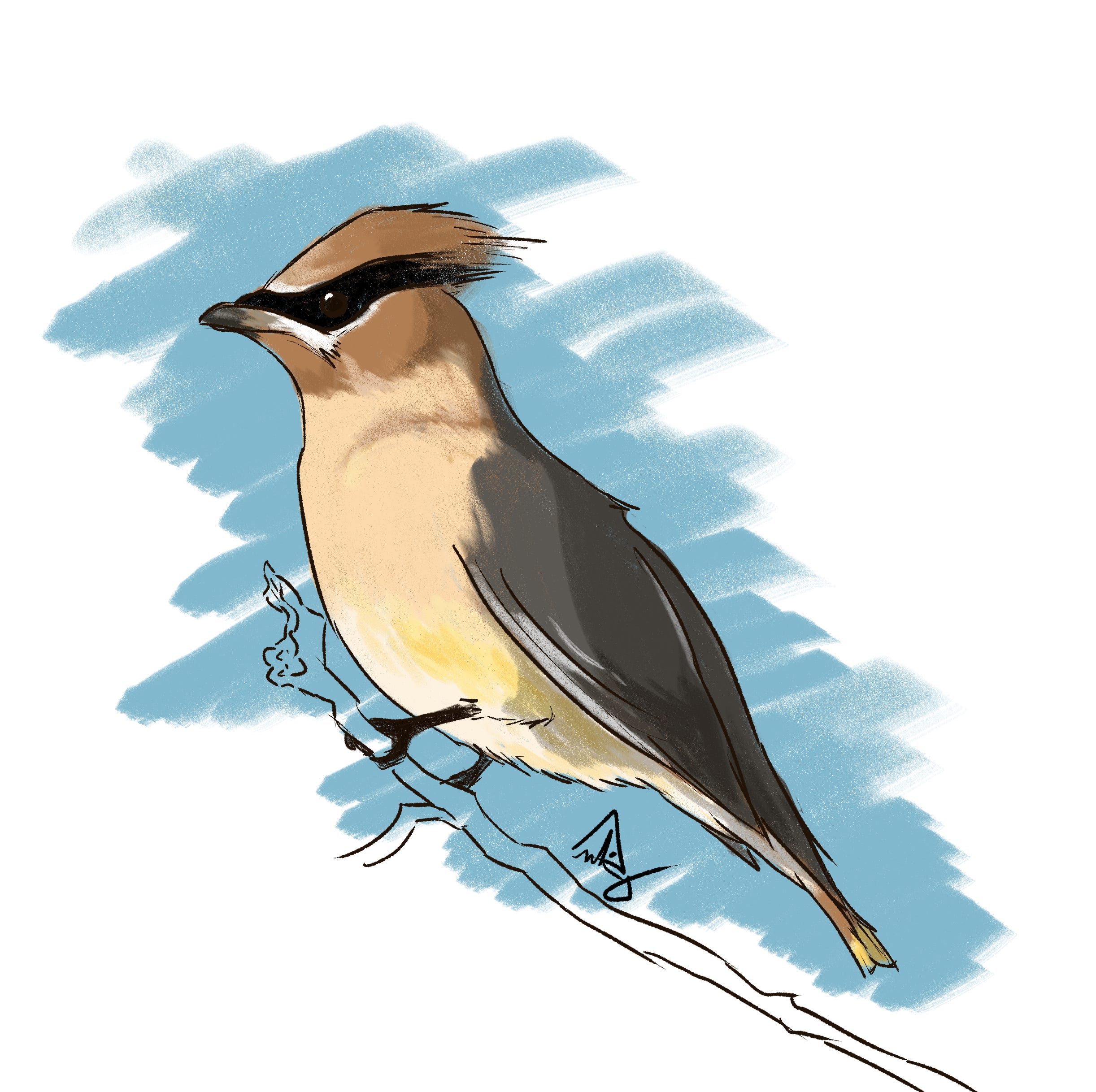
All across North America, if you look up into the right fruit tree, you might spot a group of special little plump birds. Ruddy brown heads topped with a black mask that blends into grey wings and yellow bellies and tails mark the Cedar Waxwing. Not to mention the titular red waxy drops at the edge of their wings (which I failed to illustrate). You’d better be quick, though, Cedar Waxwings are ravenous eaters, and a large group can stop, eat, and leave a fruit plant bare in a matter of minutes[7][2].
For bird watchers, they are popular to attract into yards with flat landing spots laden with fruits[10]. Out in wild they are known to eat the fruits of dogwood, mistletoe, holly, juniper, cherry laurel, insects, sometimes tree sap and flower petals[2][3][8]. When it comes to fruits, if they are red and 7-8 mm, they seem to be having a good time[2].
Where to find it and my experience:
B. cedrorum can be found in a variety of ecosystems from open woodlands to Forest edges, parks, and orchards[4][3][7][11]. Cedar Waxwings don’t really migrate, at least not in a cycle you may have heard of from other species[1][7]. Rather than following a specific season consistently, they travel in groups looking for spots where there is plenty to fill their bellies[1][5]. So if a population lives in an area with stricter seasons, they will likely move away for the winter, but if there are winter fruits, they are known to hunker down right where they are[2][3][1][7].
So, look for the food, and if you are North of Carmel or South of Santa Barbara, you might have a better chance of spotting them than in the flat areas of the Central Valley[4][3]. In August, going into the winter, you are more likely to spot the larger flocks[3][4].
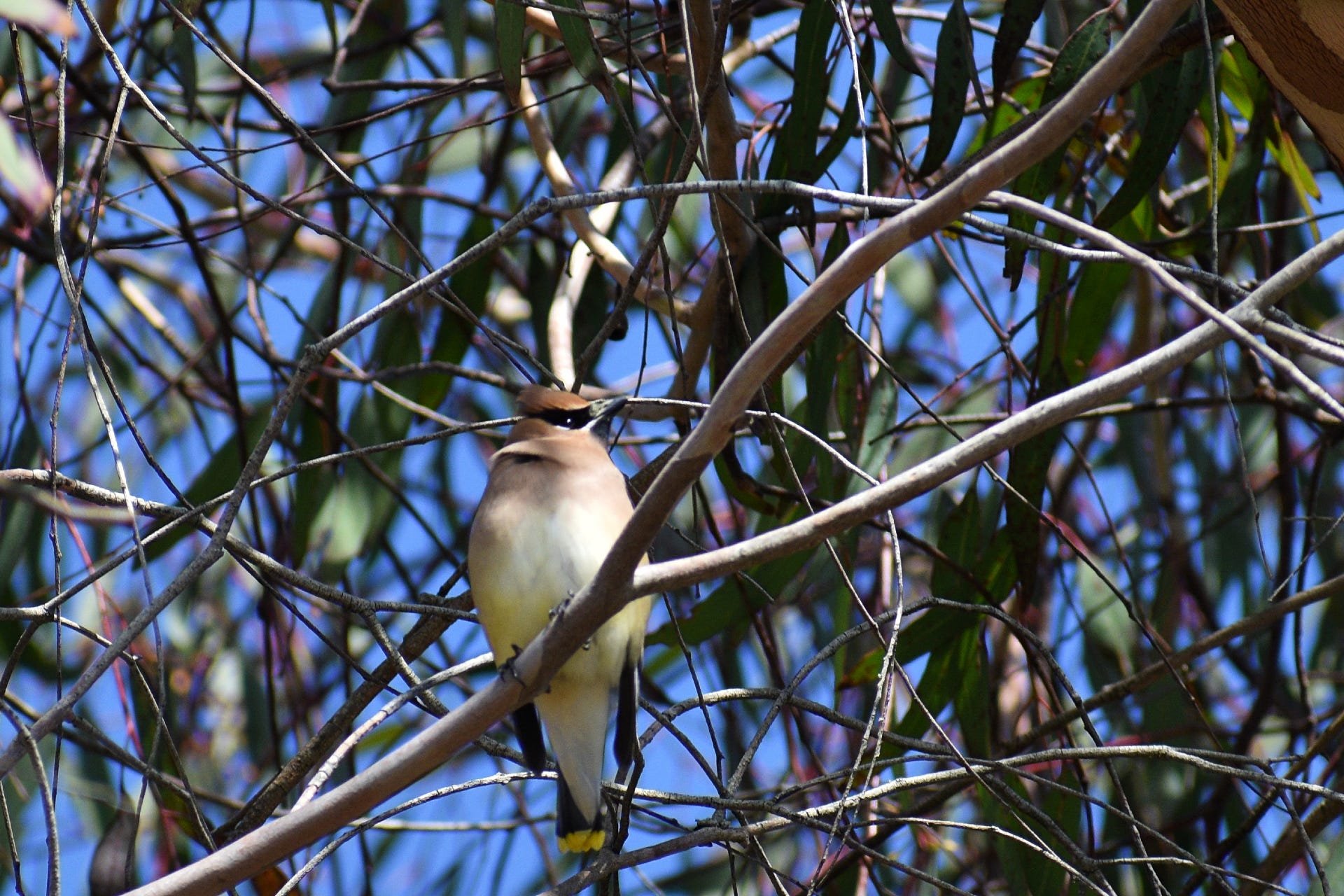
I took a picture of a Cedar Waxwing in 2022, perched on a Eucalyptus, likely just passing through. This is the only time I remember seeing them, but that doesn’t mean they aren’t around. I’m still trying to learn bird calls, and I wasn’t always looking up into the tree line. So who knows how many just flew on above my head.
Interesting Anatomy and Mating facts:
As I briefly mentioned above, Cedar Waxwings and the entire family which they belong to are named after the red drops of wax that are excreted at the base of their secondary wings[9][6].
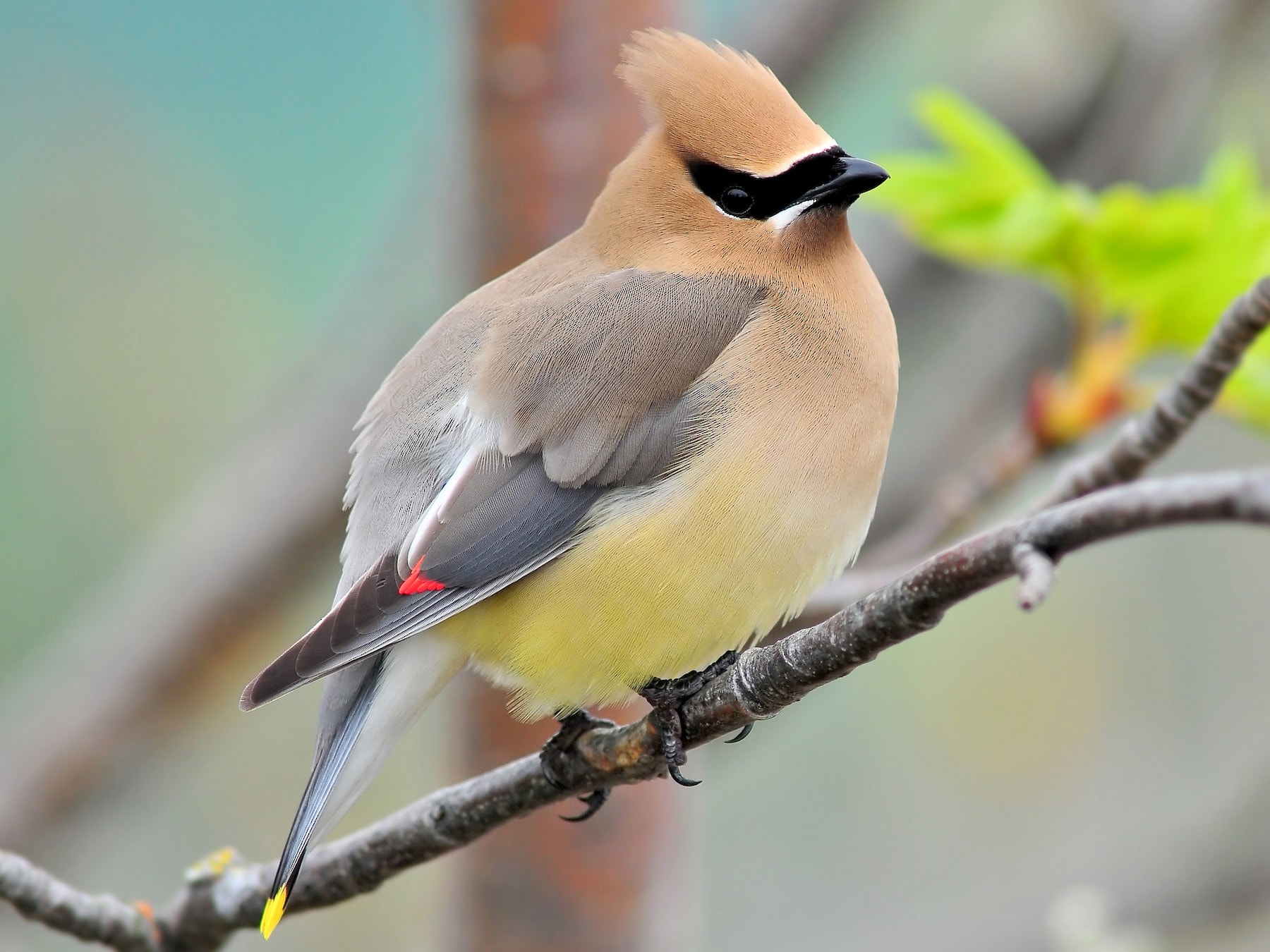
Apparently, we aren’t sure why Waxwings have wax on their wings[5][9]. The running theory is that it has something to do with attracting a mate[5][9]. Cedar Waxwings don’t express sexual dimorphism —the males and females look nearly identical, although the males tend to have darker chins[6]— and both sexes produce the waxy secretions, although not every individual does[5][9]. According to Mountjoy and Robertson (1988), Cedar Waxwings older than two years with thicker and more wax drops start nesting months earlier than their younger counter parts and tend to rear more young in a breeding season[9]. So the drops might not just be attractive, but also may be a direct indicator of reproductive health and success.
Today’s Art:
This is an older quick sketch done in Clip Studio Paint. It was a fun warm-up sketch and a bit of an exploration of color. This was made in June 2025, when I was trying to improve my Scientific Illustration skills.
I also thought it might be fun to add a photo I took of a Cedar Waxwing from the same year. I take a lot of wildlife photos that I tend to sit on, only pulling them out when I get lucky enough for someone to ask me out of the blue. Unfortunately, birds in Monterey are not a common topic of conversation. I figure I should probably share them more with you guys, so expect more photography in the California Native series.
Sources and more places to read here:
Jean M. McPherson, A Field Study of Winter Fruit Preferences of Cedar Waxwings, The Condor: Ornithological Applications, Volume 89, Issue 2, 1 May 1987, Pages 293–306, https://doi.org/10.2307/1368482
https://www.nwf.org/Educational-Resources/Wildlife-Guide/Birds/Cedar-Waxwing
https://naturemappingfoundation.org/natmap/ca/facts/birds/cedar_waxwing.html
WHITTLE, H. G. (1928). THE BIOGRAPHY OF A CEDAR WAXWING. Bulletin of the Northeastern Bird-Banding Association, 4(3), 77–85. http://www.jstor.org/stable/43043679
D. James Mountjoy, Raleigh J. Robertson, Why Are Waxwings “Waxy”? Delayed Plumage Maturation in the Cedar Waxwing, The Auk, Volume 105, Issue 1, January 1988, Pages 61–69, https://doi.org/10.1093/auk/105.1.61
The committee on classification and nomenclature of the American Ornithologists’ Union. The A.O.U. Checklist of North American Birds. 1983. 6th ed., Lawrence, Kansas, American Ornithologists’ Union, pg. 581-582.
Rothstein, S. I. (1976). Cowbird Parasitism of the Cedar Waxwing and Its Evolutionary Implications. The Auk, 93(3), 498–509. http://www.jstor.org/stable/4084951
https://www.biodiversitylibrary.org/page/52155308#page/238/mode/1up
I have two Cedar waxwing memories from childhood.
I grew up on the foggy Monterey coast, and my mom kept a large pyracantha bush outside our kitchen window. The window faced the street, but the house was set back a bit and the street was relatively quiet, and maybe that made our pyracantha popular with the Cedar wax wings. They would come swiping in an enlarged chattering bunch of maybe 15 or 20 birds and clear off every last bar in a matter of minutes and then off they'd go!
Local lore had it, and I don't know if this is true that pyracantha berries tend to ferment. At least that was my mom's explanation for why more than once we would look out the large picture window onto our back garden, which went down to the floor and see Harantis staggering around on the back deck. We had to make sure to keep our big yellow cab indoors coming out that I think you ever captured any birds in his entire life cause he was really quite the scary dickhead in spite of being a big 18 pound boy. He would hunker down on the floor of our family room looking straight out on the back deck, making noises and thrashing his tail I swear if we looked closely we would've seen him licking his lips!
I love your Cedar waxwing sketch! Beautifully captures their colors!
I have two Cedar waxwing memories from childhood.
I grew up on the foggy Monterey coast, and my mom kept a large pyracantha bush outside our kitchen window. The window faced the street, but the house was set back a bit and the street was relatively quiet, and maybe that made our pyracantha popular with the Cedar wax wings. They would come swiping in an enlarged chattering bunch of maybe 15 or 20 birds and clear off every last bar in a matter of minutes and then off they'd go!
Local lore had it, and I don't know if this is true that pyracantha berries tend to ferment. At least that was my mom's explanation for why more than once we would look out the window and our back garden, which went down to the floor and see Harantis staggering around on the back deck. We had to make sure to keep our big yellow cab indoors coming out that I think you ever captured any birds in his entire life cause he was really quite the scary dickhead in spite of being a big 18 pound boy. He would hunker down on the floor of our family room looking straight out on the back deck, making noises and thrashing his tail I swear if we looked closely we would've seen him licking his lips!