
Bold Jumping Spider
California Native of the Week
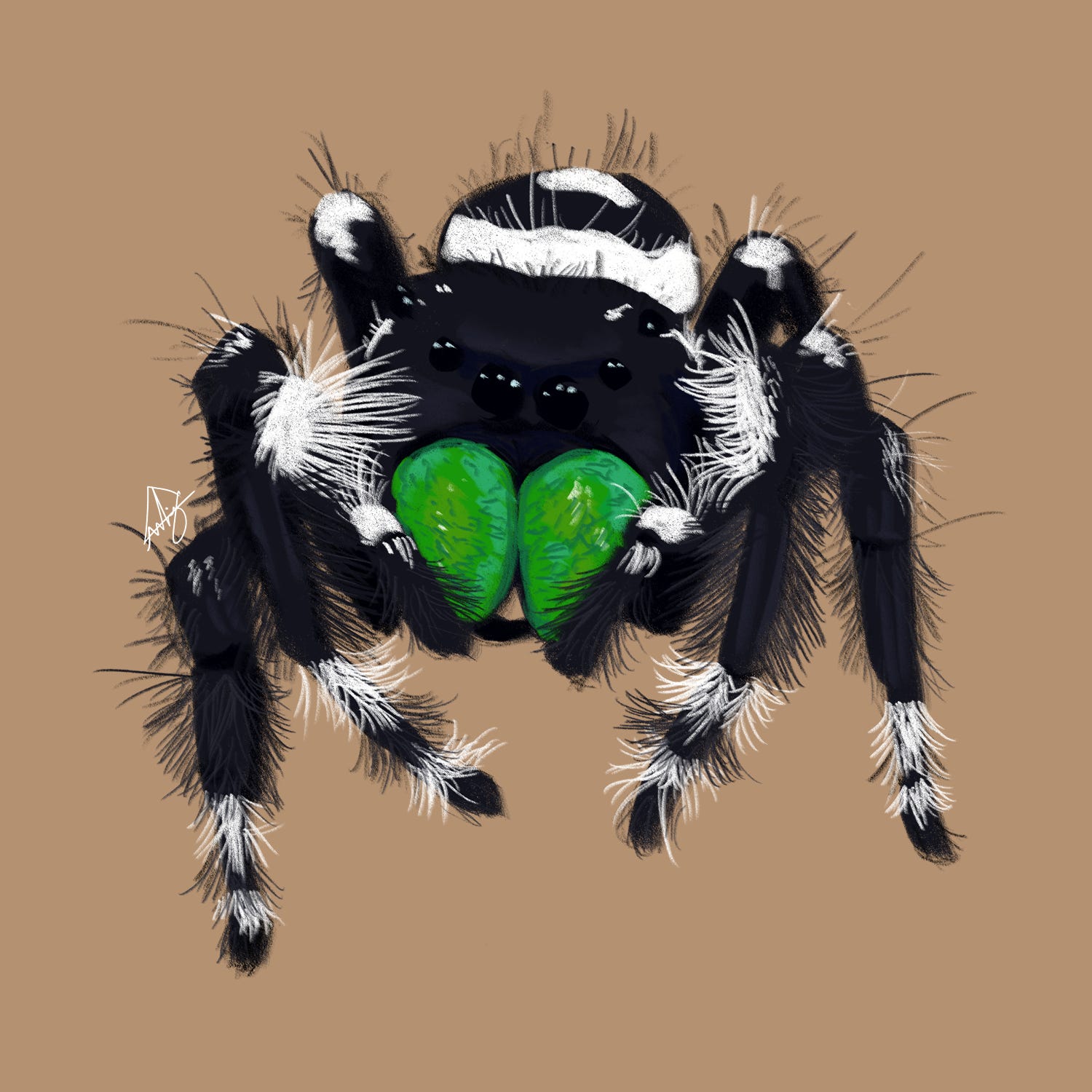
Even if you don’t like spiders, I hope you come to love these little guys. Belonging to the family with one of my favorite monikers—Salticidae— Phidippis Audax are fast, wide-eyes and fuzzy. Bold Jumping Spiders are easy to ID from their iridescent green chelicera (fangs), stout black bodies, and spots. Younger Bold Jumping Spiders tend to have orange spots, while older individuals have white spots and bands on their legs[1].
Unlike other spiders you might be used to, Jumping Spiders don’t wait for their prey to come to them. Instead they use great speed, stealth, and killer eyesight. Despite only being 6 to 19 millimeters long, they can jump as far as 4-6 inches in one leap, that’s almost 7x the length of their bodies[1][4]!
Choosing this species was a bit…contentious. It’s actually, not clear if this Spider is native to California, or traveled westward with agriculture, and urbanization[5]. However, there is no doubt it is native to the US overall, and reductions to range by state lines can be a bit complicated. A lack of sighting, does not mean lack of existence[5][3][1][2].
Where to find it and my experience:
Bold Jumping spiders, don’t get their name from their bright colors, rather it’s based on their fearlessness[5]. So, if you come across them and they stare or approach don’t freak out! Found all over the United States, southern Canada, and northern Mexico, these guys can be quite friendly. There seems to be few or no records of them biting, preferring to run or jump when threatened. In fact, if they are curious enough and you are patient, you can hold out a hand for them to crawl on.
I have a Bold Jumping Spider that lives near my house, and some days I come home to it perched on top of my doorbell. We usually do a starting contest with each other —having no eyelids, it wins, every time— and then I head inside. It mostly spends time relaxing, staring, and hopefully eating the aphids on my Clarkia.
Interesting Mating fact:
Jumping Spiders can be quite romantic if they want to be and Bold Jumping Spiders are no exception. To attract females, males dance with their palps — the shorter front legs next to the chelicera— raised moving in a zigzag motion inching closer to the female 1 cm at a time[3]. They have to be careful though, because most mating attempts are unsuccessful, and sometimes that means one individual becoming a snack, often it’s the smaller male. Females tend to wait for males, building chambers and hunkering down during the mating period. Most females females will move around if a Male doesn’t show up, every few days, but a record in 1955 mentioned a female who waited unsuccessfully for 24 days for a mate to arrive[4]. Mating tends to be less than five minutes, but copulation itself has a huge range in time; A record from 1889 observed copulations that lasted 1 minute and 3 hours and 46 minutes[3].
Today’s Art:
It’s been a busy week, so this piece is a bit older, and was drawn unrelated to the series. I drew it July 2025 just to practice fuzzy anatomy with extra legs. If you were subscribed previously, you may have seen a post about it with few words to go with it. I illustrated this piece using Clip Studio Paint.
Sources and more places to read here:
https://www.whatsthatbug.com/bold-jumping-spider-all-you-need-to-know-in-a-nutshell/
https://www.inaturalist.org/observations?quality_grade=research&subview=map&taxon_id=53809&verifiable=any
https://www.biodiversitylibrary.org/page/50676558#page/362/mode/1up
https://www.biodiversitylibrary.org/page/2403244#page/21/mode/1up
https://animalia.bio/phidippus-audax