
Anise Swallowtail
Papilio zelicaon - California Native Series

Papilio zelicaon is a butterfly that is strikingly gorgeous at every stage of its life. It is so iconic when it is young that googling caterpillar places it as the first result. For a species that can be found nowhere else in the world but the Western United States, that is either impressive or a direct reflection of Google’s geographic bias. Either way, I knew about these caterpillars by appearance long before I knew them by name. The adults deserve just as much praise, with pale yellow and black forewings and patches of iridescent blue on the hindwings. They tend to be smaller than other large yellow swallowtails in the area, and their pale yellow wings are more checkered than striped[3][5].
Where to find it and my experience:
Anise Swallowtails can only be found in the Western US, Western Canada, and the Northern part of the Gulf of Mexico[4][5]. Here in California, you can find them pretty much anywhere a carrot might grow, basically all ecosystem types except for dense conifer forests[4][3]. I think this is because the forest floor offers little sun access for low growing leafy plants. They are most common between February and November[3].
On April 26th, we spotted a perfectly green Papilio zelicaon in its second instar. Just as a quick refresh, we were along on the Guadalupe River Trail when we spotted the caterpillar nestled on some fennel. It was cold and rainy, so it didn’t move much, but it was still an amazing find. You can check out the Anise Swallowtail and other insects we spotted in the article below. As for the adults, I tend to see them fluttering around the city in San Jose.
A little Rain Won't stop Us!

In preparation for Sunday’s Bug Hike, I tried to look at the forecast beforehand. It wouldn’t have been the first time that I failed to do so, and we had to cancel due to poor weather.
Interesting Diet and Defense fact:
Butterflies are notably picky, only choosing a specific host plant to lay their eggs on. For the Anise Swallowtail, it’s pretty much anything in the carrot family. You might expect them to stick to the native carrots —water hemlock, cow parsnip, queen anne’s lace, and more— but it’s not uncommon to find them on non-native ones — dill, parsley, celery, and poison hemlock[1][3][5]. I hadn’t realized how adaptive butterflies could be, and when we spotted an Anise Swallowtail on our [date] bug hike, I started to doubt my identification of a non-native fennel I’d seen hundreds of times (you never know!). Occasionally, they will use citrus as a host; this seems to happen sparingly, and carrots are the preferred choice[1][3].
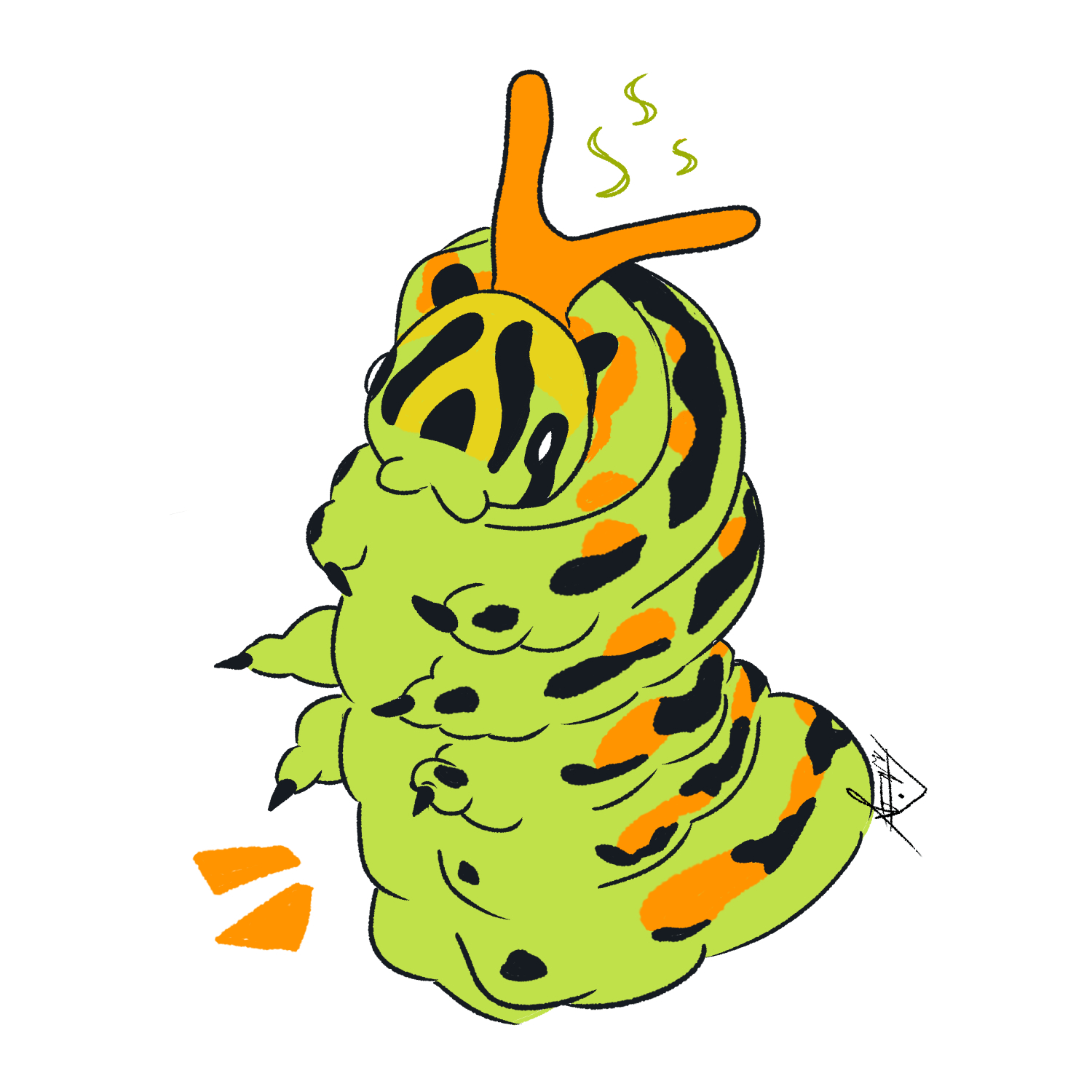
All Swallowtail caterpillars have a defensive superpower. A bright, Y-shaped, orange, sticky organ tucked behind their head called the Osmeterium; when threatened, they push out the Osmeterium and release a disgusting smell[2]. I’ve never smelled it before, but some say the smell can range from parsley to bird droppings to citrus; it seems to vary from species-to-species and person-to-person[6].
Today’s Art:
Today’s art is an Anise Swallowtail showing off its Osmeterium in an adorably threatening display. I drew it by pencil in my sketchbook first, then I outlined and colored it in using Clip Studio Paint. I’ve also done a much simpler design than usual, because I wanted to try something a bit different.
I’ve decided to sell stickers!
If you like what I do and you’d like to support me, you can now get something physical to take home with you. I plan to design more stickers, art prints, and various other things to help celebrate our non-human neighbors.
So if you are interested in picking up a sticker or even contributing to what I’m doing here, check out my Buy Me A Coffee.
Sources and more places to read here:
https://butterfly.ucdavis.edu/butterfly/papilio/zelicaon
https://www.nature.com/articles/s41598-023-33390-x
Arthur M. Shapiro, Tim D. Manolis. Field Guide to Butterflies of the San Francisco Bay and Sacramento Valley. 2007. 1st ed., pg. 94-95.
https://www.inaturalist.org/observations?quality_grade=research&subview=map&taxon_id=51097&verifiable=any
https://fieldguide.mt.gov/speciesDetail.aspx?elcode=IILEP94090
https://askentomologists.com/2014/12/23/what-does-an-osmeterium-smell-like-does-the-smell-differ-between-species/